
Africa
Malawi is a landlocked country in southeastern Africa, bordered by Tanzania to the north, Mozambique wrapping around its east and south, and Zambia to the west, with Lake Malawi running along much of its eastern border.
Malawi's name likely comes from the Maravi people, an early kingdom in the region, with the name possibly meaning 'flames' or 'rays of light,' referring to reflections on Lake Malawi at sunrise as seen by early travellers.
Landscape: Dominated by Lake Malawi along its eastern border, with highlands and plateau making up much of the rest of the country.
Climate: Tropical, moderated by altitude, with a wet and dry season.
Food: Nsima, a maize porridge, is the everyday staple, typically served with a vegetable or fish side dish drawn from Lake Malawi.
Lilongwe became Malawi's capital in 1975, replacing Zomba, chosen for its more central location within the country. With a population of around 1.1 million, it was developed with South African assistance as a planned city, giving it a notably different, more spread-out character than many other African capitals.
The fish eagle, closely resembling the bald eagle in appearance, is Malawi's national bird, and Lake Malawi itself functions as the country's most significant unofficial national symbol, dominating both the landscape and national identity.
Malawian wood carving, particularly chairs and figures produced by Chewa and Yao craftsmen, and traditional Gule Wamkulu masked dance, a secretive Chewa ceremonial tradition recognised by UNESCO, remain significant living practices. Traditional Malawian pottery, produced largely by women using techniques passed down through generations, remains both a practical and artistic craft in rural communities.
Lake Malawi, the third-largest lake in Africa and a UNESCO World Heritage Site, dominates the country's eastern border and is renowned for having more fish species than any other lake in the world. Zomba Plateau, a highland area with waterfalls and forest trails, was the country's former colonial capital and remains a popular retreat.
Lake Malawi is home to an extraordinary number of cichlid fish species, many found nowhere else, making it one of the most significant sites globally for studying rapid evolutionary diversification.
Malawi is majority Christian, with a significant Muslim minority, and the country is known for having one of the more stable and peaceful post-independence histories in the region, sometimes called the 'Warm Heart of Africa' for its reputation of hospitality.
Malawi is a significant exporter of tobacco, which forms the majority of the country's export revenue, alongside tea and sugar.
Independence Day on July 6th marks 1964, when Malawi gained sovereignty from British colonial rule. Given Malawi's significant Christian population, Christmas and Easter are both widely observed, and Kamuzu Day in May honours Hastings Banda, the country's first post-independence leader, a still-significant figure in Malawian historical memory. Malawi's Mothers' Day in October recognises the social importance of mothers within Malawian family structures.
Football holds the largest domestic following in Malawi by a wide margin, even without major international competitive success to match, and netball has produced some of the country's most significant recent international sporting achievements, the women's national team having competed at multiple World Cups. Malawian athletics has produced occasional competitors at continental championships.
Malawi is a presidential republic, with a President serving as both head of state and government. The country transitioned to multi-party democracy in 1994 following three decades of one-party rule under Hastings Banda, and Malawi's 2020 election rerun, ordered after courts found irregularities in the original vote, was a genuinely notable moment for African judicial independence. Malawi's economy relies heavily on tobacco exports, making it particularly exposed to shifts in global demand. Malawi's tea and tobacco industries remain central pillars of its agricultural export economy.
Sapitwa Peak, on Mount Mulanje, is Malawi's highest point at 3,002 metres. Lake Malawi's shoreline holds the lowest point at around 472 metres above sea level, Malawi's lowest point despite being well above true sea level, since the country is entirely landlocked. Malawi's terrain is dominated by the Great Rift Valley and Lake Malawi, alongside surrounding highland plateau areas.
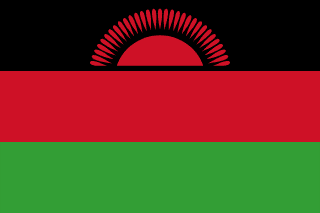
There's no especially close match for Malawi's flag, the black-red-green horizontal stripes topped by a rising red sun with 31 rays are a distinctive combination, that specific sun placement, sitting directly atop the black stripe rather than centred, not closely replicated by any other national flag.
Adopted in 1964 at independence, briefly changed in 2010 to add a full sun before public objection led to the original rising sun design being restored in 2012.
Home to Lake Malawi, which contains more fish species than any other lake on the planet.
Play today's Flagpie →© Flagpie 2026