
Europe
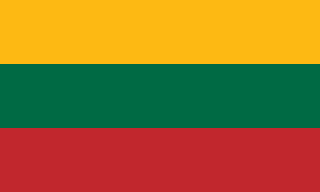
Lithuania is the southernmost of the three Baltic states, bordered by Latvia to the north, Belarus to the east and south, and Poland and Russia's Kaliningrad exclave to the southwest.
Lithuania's name origin is debated, with one common theory tracing it to a small local river name, gradually extended to describe the wider territory that became the medieval Grand Duchy of Lithuania, once one of the largest states in Europe.
Landscape: Mostly flat lowland dotted with lakes and forest, with a short Baltic coastline including the Curonian Spit, a narrow sand dune peninsula.
Climate: Temperate, cold winters and mild summers.
Food: Cepelinai, potato dumplings filled with meat, are a genuine national dish, named for their resemblance to zeppelin airships.
Vilnius was founded in the 14th century, according to legend after Grand Duke Gediminas dreamed of an iron wolf howling atop a hill, which he interpreted as a sign to build a city there. With a population of around 580,000, its Old Town, one of the largest in Central Europe, is a UNESCO World Heritage Site.
The white stork is closely associated with Lithuania, which has one of the highest densities of breeding storks in the world, and the rue flower, tied to traditional wedding customs, holds particular folk significance.
Lithuanian amber jewellery, drawing on the Baltic region's ancient amber deposits, and traditional woven sashes with intricate geometric patterns, remain significant craft traditions, the latter recognised by UNESCO. Lithuanian Easter egg decorating, using wax-resist and etching techniques, remains a widely practised seasonal craft tradition.
Trakai Island Castle, built on an island in a lake near Vilnius, is one of Lithuania's most recognisable landmarks, and the Curonian Spit, a narrow sand dune peninsula shared with Russia's Kaliningrad region, is a UNESCO World Heritage Site. The Hill of Crosses, covered with tens of thousands of crosses placed by pilgrims over centuries, is one of Lithuania's most striking and unusual religious sites.
Lithuania's forests support European bison, reintroduced after near extinction, alongside significant populations of wolves and lynx, and its wetlands are internationally important stopover points for migratory birds.
Lithuania is historically Roman Catholic, notably the last country in Europe to formally adopt Christianity, in 1387, and Lithuanian national identity remains closely tied to preserving the Lithuanian language, one of the oldest living Indo-European languages still spoken.
Lithuania is a significant exporter of machinery, refined petroleum products, and furniture, with a growing technology and financial services sector in recent years.
Restoration of the State Day on February 16th marks 1918, when modern Lithuania was first re-established, and Restoration of Independence Day on March 11th marks 1990, when Lithuania became the first Soviet republic to formally declare independence, a significant early domino in the USSR's eventual collapse. Midsummer (Joninės) in late June remains widely celebrated with bonfires and traditional herb-gathering rituals. Vėlinės, All Souls' Day in November, is marked nationwide by lighting candles at family graves after dark, creating a striking visual tradition.
Basketball is treated as something close to a national religion in Lithuania, the sport having taken hold during the country's brief interwar independence and remaining central to national identity even through decades of Soviet rule, with the national team's victories, particularly at the 2000 Olympics against the Soviet successor team Russia, celebrated as deeply symbolic. Football also draws a significant domestic following. Lithuanian rowing and athletics have also produced several notable Olympic competitors in recent decades.
Lithuania is a semi-presidential republic, splitting executive authority between a directly elected President, who holds significant power particularly over foreign policy, and a Prime Minister accountable to the Seimas, Lithuania's single-chamber parliament. The country was the first Soviet republic to formally declare independence, in March 1990, and later joined both the European Union and NATO. Lithuania has taken an increasingly prominent role in regional security discussions given its border with Russia's Kaliningrad exclave.
Aukštojas Hill is Lithuania's highest point at just 294 metres, reflecting the country's generally flat, low-lying Baltic terrain. The lowest point sits at sea level along Lithuania's short Baltic coastline.
There's no especially close match for Lithuania's flag, the yellow-green-red horizontal tricolour is distinctive enough as a specific combination among national flags, though several African nations share the same three colours, arranged completely differently and in a different context entirely, making any real confusion between them essentially nonexistent.
First adopted in 1918, suppressed during Soviet rule, and formally restored in 1989 shortly before full independence.
The exact geographic centre of Europe, according to the French National Geographic Institute, lies just north of its capital, Vilnius.
Play today's Flagpie →© Flagpie 2026