
Africa
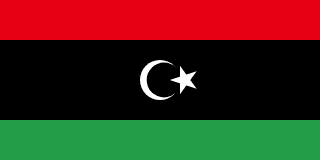
Libya sits on the Mediterranean coast of North Africa, bordered by Tunisia and Algeria to the west, Niger and Chad to the south, and Sudan and Egypt to the east.
This flag has the highest proportion of black of any flag in Flagpie, at 49%.
Libya's name comes from an ancient Egyptian term referring to a people living west of the Nile, later adopted by the Greeks and Romans to describe the wider region of North Africa beyond Egypt.
Landscape: Over 90% desert (the Sahara and Libyan Desert), with a narrow, more fertile Mediterranean coastal strip where most of the population lives.
Climate: Desert climate across most of the country, Mediterranean along the narrow coastal strip.
Food: Bazin, a dense dough made from barley flour, typically served with a meat and vegetable stew, is a traditional Libyan dish.
Tripoli has been a significant Mediterranean port since Phoenician times, later becoming a major centre under Ottoman and Italian colonial rule before serving as capital of independent Libya since 1951. With a population of around 1.1 million, it remains the country's largest city and primary political centre, though ongoing political instability has significantly affected its governance in recent years.
The eagle, tied to Islamic and Arab nationalist symbolism shared across the region, appears on Libya's coat of arms, and the country's flag underwent several changes reflecting its shifting 20th and 21st-century political history.
Libyan silver jewellery, particularly from Berber communities, and traditional woven rugs reflect deep regional craft traditions shared with neighbouring Tunisia and Algeria. Traditional Libyan leatherwork and metal engraving, particularly among Berber craftsmen, reflect techniques passed down over many generations.
Leptis Magna, one of the best-preserved Roman cities in the entire Mediterranean, and the ancient rock art of the Acacus Mountains, both UNESCO World Heritage Sites, reflect Libya's deep historical layering, though ongoing instability has limited access to and preservation of many sites. Ghadames, an ancient oasis town sometimes called 'the pearl of the desert,' features distinctive covered walkways designed to shield residents from the Saharan heat.
Libya's desert regions support fennec foxes and, in more remote areas, small populations of Barbary sheep, both adapted to the country's overwhelmingly arid Saharan climate.
Libya is overwhelmingly Sunni Muslim, and the country's population includes both Arab and Berber communities, with Berber language and identity gaining somewhat greater recognition since the 2011 revolution.
Libya holds the largest proven oil reserves in Africa, and crude oil exports form the overwhelming majority of the country's export revenue, though production has been significantly affected by ongoing political instability since 2011.
Independence Day on December 24th marks 1951, when Libya became the first country to gain independence through the United Nations, following a brief period of post-war international administration. Liberation Day on October 23rd marks 2011, when the National Transitional Council declared the country liberated following the civil conflict that ended Muammar Gaddafi's decades-long rule.
Football holds the largest domestic following in Libya by a wide margin, even amid the significant political instability the country has experienced in recent years. Libyan athletes have historically also competed in athletics and swimming at the international level, though ongoing internal conflict has significantly affected the country's sporting infrastructure and international competitive presence. Libyan athletes have historically competed in weightlifting at regional and continental level.
Libya's political situation has remained genuinely unstable and contested since the 2011 revolution that ended Muammar Gaddafi's 42-year rule, with rival governments and armed factions competing for control of different parts of the country in the years since, making a single, settled description of its governmental structure difficult to give with confidence. Libya's oil wealth, among the largest reserves in Africa, remains central to any future political and economic stabilisation efforts. Libya holds the largest proven oil reserves in Africa, a resource central to any future national recovery. Libya's ancient Roman ruins at Leptis Magna remain among the best-preserved anywhere in the Mediterranean.
Bikku Bitti, in the Tibesti Mountains near the border with Chad, is Libya's highest point at 2,267 metres. The Sabkhat Ghuzayyil depression holds the lowest point at around 47 metres below sea level.
Egypt, Syria, Iraq, and Yemen all use variations of the same red-white-black horizontal Pan-Arab tricolour Libya's current flag does, tracing back to the 1916 Arab Revolt flag, and Libya's specific green crescent and star at the centre, restored after the 2011 revolution, is what distinguishes its current design from those regional cousins.
The current flag was originally adopted in 1951, replaced by the plain green flag from 1977 to 2011, then formally restored after the 2011 revolution.
Between 1977 and 2011, this country's flag was a plain, solid green with no design at all, the only national flag in the world at the time with just one colour.
Play today's Flagpie →© Flagpie 2026