
Europe
Latvia sits in the middle of the three Baltic states, bordered by Estonia to the north, Russia to the east, Belarus to the southeast, and Lithuania to the south, with a coastline on the Baltic Sea.
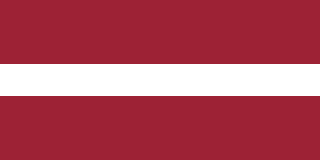
This flag has the highest proportion of maroon of any flag in Flagpie, at 80%.
Latvia's name comes from the Latgalians, one of several Baltic tribes that settled the region, whose name was gradually extended to describe the broader territory and the Latvian people as a whole.
Landscape: Mostly flat lowland, heavily forested, with a Baltic coastline including sandy beaches and dunes.
Climate: Temperate, cold winters and mild summers.
Food: Grey peas with bacon is a traditional winter staple, alongside a strong rye bread and dark bread tradition shared with its Baltic neighbours.
Riga was founded in 1201 by German crusaders and merchants, quickly becoming a major Hanseatic League trading centre due to its position on the Daugava River near the Baltic coast. With a population of around 605,000, its Old Town reflects centuries of German, Swedish, and Russian influence layered over the original Latvian foundation.
The white wagtail is Latvia's national bird, and the oak and linden trees both hold deep symbolic significance in Latvian folk tradition, historically associated with masculine and feminine strength respectively.
Latvian folk costume, with patterns and colours historically varying by region, remains worn at the country's significant song and dance festivals, and traditional amber jewellery-making draws on the Baltic Sea's long history as a source of amber. Latvia's Song and Dance Festival, held roughly every five years and drawing tens of thousands of participants, is recognised by UNESCO as an outstanding example of intangible cultural heritage.
Riga's Art Nouveau architecture district contains one of the largest collections of that style anywhere in the world, and Rundāle Palace, built in the 18th century, reflects the region's period under Baltic German nobility. Gauja National Park, Latvia's largest, contains sandstone cliffs, caves, and medieval castle ruins along the Gauja River valley.
Latvia's forests and wetlands, covering roughly half the country, support significant populations of lynx, wolves, and black storks, a species that has become notably rare across much of the rest of Europe.
Latvia has a mixed religious landscape, with Lutheran and Catholic Christian traditions both historically significant, alongside a large Russian-speaking minority population with its own distinct cultural and religious traditions.
Latvia is a significant exporter of wood and timber products, given its extensive forest cover, alongside machinery and agricultural goods.
Independence Day on November 18th marks 1918, when Latvia first declared sovereignty, and Midsummer (Jāņi) on June 23rd and 24th is arguably the country's most beloved celebration, involving bonfires, flower crowns, and a specific type of caraway seed cheese traditionally eaten only at this time of year. Restoration of Independence Day on May 4th marks 1990, when Latvia formally began the process of re-establishing sovereignty from the Soviet Union. Latvia's own Song and Dance Festival, shared in spirit with Estonia's, similarly draws enormous participation and UNESCO recognition. Latvia's amber-gathering traditions along the Baltic coast remain a genuinely popular seasonal pastime.
Ice hockey holds a place close to the centre of Latvian national identity, matches against larger neighbouring nations treated as significant national events regardless of the result. Basketball also carries deep historical roots, Latvia having been a founding participant in some of Europe's earliest organised basketball competitions in the 1930s. Latvia has also produced notable success in the bobsled and luge, sports well suited to the country's winter climate.
Latvia is a parliamentary republic, with a President elected by parliament serving a largely ceremonial role and a Prime Minister holding real executive power, accountable to the Saeima, Latvia's single-chamber parliament. The country regained independence from the Soviet Union in 1991, and later joined both the European Union and NATO in the 2000s.
Gaiziņkalns is Latvia's highest point at just 312 metres, reflecting the country's generally flat, low-lying Baltic geography similar to its neighbours. The lowest point sits at sea level along Latvia's Baltic coastline.
Austria and Peru both share Latvia's underlying red-white-red horizontal structure, though Latvia's red is a distinctly darker, maroon shade with roots in a centuries-old origin legend, different enough in tone from Austria's brighter red that a careful look can usually tell them apart, even if a passing glance sometimes can't.
One of the oldest flag designs in the world, with a dark red version documented as far back as the 13th century, formally readopted as the national flag in 1990.
Home to one of the largest remaining populations of White Stork in Europe.
Play today's Flagpie →© Flagpie 2026