
Asia
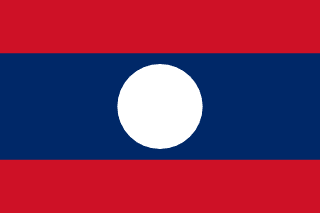
Laos is the only landlocked country in Southeast Asia, bordered by China to the north, Vietnam to the east, Cambodia to the south, and Thailand and Myanmar to the west.
Laos's name comes from the Lao people, the country's dominant ethnic group, with the French colonial-era plural 's' added to the name, a spelling that has stuck in English despite not reflecting how Laotians pronounce the country's name themselves.
Landscape: Mountainous and landlocked, with the Mekong River forming much of its western border and lowland plains along its banks.
Climate: Tropical monsoon, hot with a distinct wet season.
Food: Laap, a spiced minced meat salad, is widely considered the national dish, alongside sticky rice eaten with nearly every meal.
Vientiane has served as Laos's capital since the 16th century, when the Lan Xang kingdom moved its centre there, and remains the country's political and economic hub today. With a population of around 950,000, it retains a notably relaxed, low-rise character compared to many other Southeast Asian capitals.
The Asian elephant holds deep historical significance in Laos, once called the 'Land of a Million Elephants' (Lan Xang) after the medieval kingdom, and the champa flower (frangipani) is closely tied to Laotian culture and hospitality customs.
Lao silk and cotton weaving, with distinctive regional patterns passed down through generations, remains a genuinely significant craft industry, and traditional Lao silverwork, historically used for ceremonial items, is still actively produced. Traditional Lao baci ceremonies, involving tying strings around the wrist for blessing and good fortune, remain a genuinely observed cultural practice at significant life events.
The Plain of Jars, scattered with thousands of mysterious ancient stone jars whose original purpose remains debated, and Luang Prabang, a well-preserved former royal capital and UNESCO World Heritage Site, are both among Laos's most significant sites.
Laos's remaining forests are home to Asian elephants and, increasingly rarely, tigers, and the country was the site of the 1992 discovery of the saola, a previously unknown large mammal species found only in the Annamite mountains shared with Vietnam.
Laos is majority Theravada Buddhist, and young Laotian men traditionally spend time as monks at some point in their lives, a practice that remains widely observed alongside the country's officially communist political system.
Laos is a significant exporter of hydroelectric power, particularly to neighbouring Thailand, alongside copper and other minerals, with hydropower export forming an increasingly central part of the national economy.
Independence Day (National Day) on December 2nd marks 1975, when the Lao People's Democratic Republic was established following the end of the Laotian Civil War. Lao New Year (Pi Mai) in mid-April, closely related to similar water festivals across Buddhist Southeast Asia, is the country's most significant traditional celebration, involving temple visits and communal water-splashing.
Football and sepak takraw, a sport combining elements of volleyball and football, both hold significant followings in Laos, closely tied to the wider Southeast Asian sporting culture shared across the region. Traditional Lao boxing and kickboxing also carry cultural significance, related to similar combat sports found in neighbouring Thailand and Cambodia. Lao athletics participation has grown through the country's involvement in regional Southeast Asian Games.
Laos is a one-party socialist state governed by the Lao People's Revolutionary Party, with a National Assembly serving as the country's legislature, though the Party holds the real decision-making authority. The country has maintained this system since the communist Pathet Lao movement took power in 1975, one of the world's remaining explicitly communist-governed states. Laos remains one of the few countries in the world still governed under an explicitly communist one-party system. Laos has pursued significant hydroelectric development, exporting power to neighbouring Thailand and Vietnam.
Phou Bia is Laos's highest point at 2,819 metres. The lowest point is where the Mekong River exits the country in the south, sitting around 70 metres above sea level, Laos's lowest point despite being well above true sea level, since the country is entirely landlocked.
There's no especially close match for Laos's flag, the blue field with a white circle representing the moon over the Mekong River, bordered by red stripes, is distinctive enough as a combination, replacing an earlier flag that had featured a three-headed elephant, a design element the current flag doesn't carry over.
Adopted in 1975 when the communist Pathet Lao took power, replacing an older flag that had featured a three-headed elephant.
The only landlocked country in Southeast Asia, and home to the mysterious 'Plain of Jars,' thousands of ancient stone jars whose original purpose is still debated.
Play today's Flagpie →© Flagpie 2026