
Asia
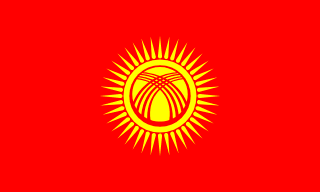
Kyrgyzstan is a landlocked, mountainous country in Central Asia, bordered by Kazakhstan to the north, China to the east, Tajikistan to the southwest, and Uzbekistan to the west.
Kyrgyzstan's name combines 'Kyrgyz,' the country's dominant ethnic group, possibly meaning 'forty tribes' or 'forty girls' in old Turkic tradition, with the Persian suffix 'stan,' meaning 'land of.'
Landscape: Almost entirely mountainous, dominated by the Tian Shan range, with very little lowland or arable terrain.
Climate: Continental, varying enormously with altitude, hot summers in the valleys and cold winters in the mountains.
Food: Beshbarmak, boiled meat served over noodles, is a shared Central Asian dish and a Kyrgyz staple, reflecting the country's nomadic herding traditions.
Bishkek was founded in 1878 as a Russian imperial fortress, later developed under Soviet rule, and became capital of independent Kyrgyzstan in 1991. With a population of around 1.1 million, it retains a notably Soviet-influenced layout, with wide tree-lined avenues and large public squares.
The snow leopard, found in Kyrgyzstan's extensive mountain ranges, is closely tied to national identity, and the tulip, native to Central Asia, holds particular symbolic significance, having given its name to the country's peaceful 2005 Tulip Revolution.
Kyrgyz felt-making, used to produce the traditional ak-kalpak hat and yurt coverings, is recognised by UNESCO, and Kyrgyz shyrdak rugs, made using intricate felt applique techniques, remain a significant living craft tradition tied to the country's nomadic herding heritage.
Lake Issyk-Kul, one of the largest and deepest mountain lakes in the world, never fully freezes despite its high altitude and cold surroundings, giving it a name meaning 'warm lake' in Kyrgyz. The Burana Tower, a partially ruined 11th-century minaret, marks the site of an ancient Silk Road settlement and remains one of the country's most significant historic monuments.
Kyrgyzstan's Tian Shan mountains support snow leopards, ibex, and Marco Polo sheep, and the country's eagle-hunting tradition, shared with neighbouring Kazakhstan and Mongolia, remains genuinely practised by some rural communities.
Kyrgyzstan is majority Muslim, though many pre-Islamic nomadic traditions, including shamanistic beliefs and practices tied to the epic of Manas, the country's foundational oral epic poem, remain culturally significant alongside Islamic faith. Bride kidnapping, though now formally illegal, remains a documented practice in some rural areas, a significant point of ongoing national debate and reform effort.
Kyrgyzstan is a significant exporter of gold, which forms a substantial share of the country's export revenue, alongside agricultural products and textiles.
Independence Day on August 31st marks 1991, when Kyrgyzstan declared sovereignty following the collapse of the Soviet Union. Nooruz, the Central Asian spring New Year shared with Iran and several regional neighbours, is celebrated with particular enthusiasm, involving traditional games, horse sports, and communal feasting. Kyrgyzstan's Constitution Day in May marks the country's post-Soviet founding legal framework.
Traditional horseback games, including kok-boru, a competitive sport involving riders and a goat carcass shared across much of Central Asia, hold deep cultural significance in Kyrgyzstan, reflecting the country's nomadic herding heritage. Wrestling has also produced notable Kyrgyz Olympic competitors, and the World Nomad Games, hosted by Kyrgyzstan, showcase traditional Central Asian sporting culture to international audiences.
Kyrgyzstan is a parliamentary republic, with a directly elected President serving alongside a Prime Minister accountable to a single-chamber parliament. The country has experienced several revolutions and changes of government since independence, generally considered more politically volatile than some of its more tightly controlled Central Asian neighbours, though also correspondingly more open in certain respects. Kyrgyzstan's economy relies significantly on gold mining and remittances from citizens working abroad.
Jengish Chokusu (Victory Peak), on the border with China, is Kyrgyzstan's highest point at 7,439 metres, the northernmost peak in the world exceeding 7,000 metres. The lowest point is along the Kara Darya river valley, sitting around 132 metres above sea level, Kyrgyzstan's lowest point despite being well above true sea level, since the country is entirely landlocked. Kyrgyzstan's terrain is overwhelmingly mountainous, with the Tian Shan range covering the majority of the country.
There's no especially close match for Kyrgyzstan's flag, the red field with a golden sun containing a stylised depiction of a traditional yurt's roof structure is a distinctive combination, that specific sun-and-yurt symbolism unique to Kyrgyzstan's own nomadic heritage. Kyrgyzstan's sun-and-yurt emblem is genuinely unique among all Central Asian nations' flags.
Adopted in 1992 shortly after independence from the Soviet Union.
Home to Lake Issyk-Kul, one of the largest and deepest mountain lakes in the world, and one that never fully freezes despite the cold.
Play today's Flagpie →© Flagpie 2026