
Europe
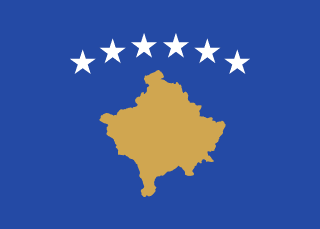
Kosovo sits on the Balkan Peninsula, bordered by Serbia to the north and east, North Macedonia to the southeast, Albania to the southwest, and Montenegro to the west.
This flag has the highest proportion of blue of any flag in Flagpie, at 88%.
Kosovo's name comes from the Serbian word for 'blackbird,' referring to the Kosovo Polje, or 'Field of Blackbirds,' the site of a pivotal and historically mythologised 1389 battle between Serbian and Ottoman forces.
Landscape: A landlocked, mountainous plateau surrounded by higher ranges along its borders.
Climate: Continental, cold winters and warm summers.
Food: Flija, a layered pastry cooked over an open flame, is a traditional dish shared with neighbouring Albania.
Pristina has served as Kosovo's capital since it became an autonomous province within Yugoslavia and remained so through the 1998-99 war and eventual declaration of independence in 2008. With a population of around 200,000, it's one of the youngest capital cities in Europe in terms of its current political status, though the settlement itself dates back centuries.
The golden double-headed eagle, shared symbolically with neighbouring Albania given the countries' close ethnic Albanian ties, appears widely in Kosovo, alongside the six-star flag adopted specifically to represent the country's diverse ethnic communities.
Kosovar Albanian filigree silverwork and traditional qeleshe felt caps, shared with Albania, remain practised crafts, and traditional carpet weaving reflects the region's historic Ottoman-era textile traditions. Traditional Kosovar Albanian music, featuring instruments like the çifteli, a long-necked lute, remains genuinely popular and performed at weddings and celebrations.
The Visoki Dečani Monastery, a UNESCO World Heritage Site, reflects Kosovo's significant Serbian Orthodox religious heritage, a source of ongoing cultural and political sensitivity given the country's more recent history.
Kosovo's Sharr Mountains National Park, shared in spirit with the wider cross-border Sharr range, supports lynx, wolves, and significant alpine biodiversity for such a small country. Kosovo's Mirusha Waterfalls and surrounding canyon offer one of the country's more scenic and biodiverse natural areas.
Kosovo is majority Muslim, predominantly ethnic Albanian, with a significant Serbian Orthodox Christian minority, a religious and ethnic divide that remains central to the country's ongoing political situation and relationship with Serbia.
Kosovo's economy remains among the smallest and least industrialised in Europe, with modest exports of metals and base materials, and significant reliance on remittances from Kosovars working abroad.
Independence Day on February 17th marks 2008, when Kosovo declared sovereignty from Serbia, a status still not recognised by all countries worldwide, including Serbia itself, making the holiday's observance a point of ongoing regional political sensitivity. Constitution Day on April 9th marks the 2008 adoption of Kosovo's founding constitutional document.
Judo holds a particularly significant place in Kosovar sporting history, the country having won its first ever Olympic medal, a gold, in the sport in 2016, a landmark achievement for the young nation's first Olympic appearance as an independent country. Football and basketball both also draw significant domestic followings, closely tied culturally to neighbouring Albania. Kosovar wrestling has also produced additional international medallists following the country's Olympic debut.
Kosovo is a parliamentary republic, with a largely ceremonial President as head of state and a Prime Minister holding real executive power, accountable to a single-chamber Assembly. The country's disputed status, recognised by many but not all UN member states, and its complicated relationship with Serbia remain the defining features of its modern political situation. Kosovo's recognition remains split internationally, with just over half of UN member states formally acknowledging its independence. Kosovo's economy remains among the smallest in Europe, with significant reliance on diaspora remittances.
Đeravica is Kosovo's highest point at 2,656 metres. The lowest point is along the Sitnica river valley, sitting around 297 metres above sea level, Kosovo's lowest point despite being well above true sea level, since the country is entirely landlocked.
Bosnia and Herzegovina's flag is Kosovo's closest conceptual relative, both were deliberately designed to be ethnically neutral following conflict, using blue and gold stars evoking the European Union flag, a shared design philosophy rather than a close visual match, since the two flags' specific layouts, Kosovo's map silhouette against Bosnia's triangle and star row, differ significantly.
Designed by Muhamer Ibrahimi.
Adopted in 2008 upon declaring independence from Serbia, chosen through a design competition organised by the United Nations specifically to be neutral, avoiding both Albanian and Serbian national symbols.
The other national flag to show an outline map of the country, adopted through a public design competition organised by the United Nations.
Play today's Flagpie →© Flagpie 2026