
Oceania
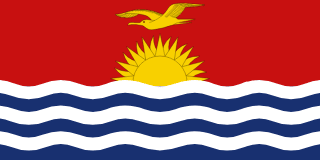
Kiribati is a nation of scattered atolls straddling the equator in the central Pacific Ocean, so spread out that it's the only country in the world to sit in all four hemispheres at once.
Kiribati's name is the local pronunciation of 'Gilberts,' referring to the Gilbert Islands, the country's main island group, named after British explorer Thomas Gilbert, who charted them in the 18th century.
Landscape: A scattered chain of low-lying coral atolls spread across a vast stretch of the central Pacific.
Climate: Tropical, warm year-round with minimal seasonal variation.
Food: Fish and coconut form the basis of most meals, reflecting the limited land available for other agriculture.
South Tarawa functions as Kiribati's capital, a narrow strip of connected islets that has become severely overcrowded relative to its land area as population has concentrated there from the country's more remote outer islands. With a population of around 63,000, it faces some of the most acute challenges from rising sea levels of any capital in the world.
The frigate bird, appearing on Kiribati's coat of arms flying above a rising sun and ocean waves, represents the vast Pacific expanse the country's islands are scattered across.
Traditional Kiribati canoe-building and woven pandanus leaf craft, including mats and thatched roofing, remain genuinely practical, everyday skills rather than purely decorative traditions, given the country's remote island geography. Traditional Kiribati dance, te kaimatoa, involves distinctive rigid upper body movements said to represent the frigate bird in flight.
The Phoenix Islands Protected Area, one of the largest marine protected areas in the world, reflects Kiribati's vast oceanic territory relative to its tiny total land area.
Kiribati's isolated atolls and the Phoenix Islands support significant seabird colonies and some of the most pristine coral reef systems remaining in the central Pacific, largely undisturbed by human development.
Kiribati is majority Christian, predominantly Roman Catholic and Protestant, and the country's culture remains deeply tied to traditional communal land ownership and extended family structures across its scattered islands. Kiribati has become an internationally cited example in discussions of climate change and rising sea levels, given how directly its low-lying atolls are threatened.
Kiribati's economy relies significantly on fishing licence revenue, since its vast exclusive economic zone gives it substantial leverage over foreign fishing fleets, alongside limited copra (dried coconut) exports.
Independence Day on July 12th marks 1979, when Kiribati gained sovereignty from British colonial rule. Given Kiribati's significant Christian population, Christmas and Easter are both widely observed, and Youth Day celebrates the country's notably young population across its scattered islands. Kiribati's Gospel Day in July celebrates the arrival of Christianity to the islands.
Weightlifting holds a genuinely significant place in Kiribati's sporting identity relative to its tiny population, the country having produced competitors at the Commonwealth Games and Olympics in the sport. Football and rugby also draw modest domestic followings given the wider Pacific sporting culture. Kiribati has also competed in rugby league at the international level.
Kiribati is a presidential republic, with a President serving as both head of state and government, elected by popular vote from candidates nominated by parliament. The country's vast oceanic territory relative to its tiny land area gives it significant leverage over fishing rights, a critical source of government revenue. Kiribati's vast maritime territory relative to its tiny land area gives it significant fishing licence revenue leverage.
Kiribati's highest point sits at just 81 metres on the island of Banaba, formerly the site of significant phosphate mining. The lowest point sits at sea level across the country's low-lying atolls, among the most vulnerable nations in the world to rising sea levels. Kiribati's scattered atolls stretch across a vast area of the central Pacific despite their tiny combined land area.
There's no especially close match for Kiribati's flag, the frigate bird flying above a rising golden sun over blue and white wave patterns is a distinctive combination, that specific wave-and-bird imagery reflecting the country's vast oceanic territory in a way not closely echoed by other Pacific nations' flags. The frigate bird motif is shared conceptually with several other Pacific nations' flags, though rendered quite differently in each.
Adopted in 1979 upon independence from Britain, kept its design from the colonial-era coat of arms rather than starting from scratch.
Spread across such a vast area of the Pacific that it's the only country in the world to sit in all four hemispheres at once.
Play today's Flagpie →© Flagpie 2026