
Africa
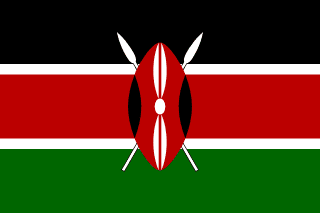
Kenya sits on the eastern coast of Africa, straddling the equator, bordered by Somalia to the east, Ethiopia to the north, South Sudan to the northwest, Uganda to the west, and Tanzania to the south.
Kenya takes its name from Mount Kenya, the country's highest peak, whose own name likely comes from a Kikuyu, Embu, or Kamba word describing the mountain's appearance, possibly relating to its white-capped peak or ostrich-like ridges.
Landscape: Includes the Great Rift Valley, savanna grassland, highland plateaus, and a coastline along the Indian Ocean.
Climate: Varies by altitude, tropical along the coast, cooler in the highlands, and arid in the north.
Food: Ugali, a maize-based staple, is eaten with nearly every meal, often alongside nyama choma, grilled meat.
Nairobi was founded in 1899 as a railway depot during construction of the Uganda Railway under British colonial rule, chosen for its relatively cool climate and central location rather than any prior settlement. With a population of around 4.4 million, it grew rapidly from a rail camp into East Africa's largest city and a major regional business hub.
The lion is widely associated with Kenyan national identity, appearing on the country's coat of arms alongside traditional Maasai shields and spears. The African fish eagle, though more closely tied to countries further south, is also commonly seen across Kenya's lakes and wetlands.
Maasai beadwork, with specific colours and patterns carrying particular meanings within Maasai culture, is among Kenya's best-known craft traditions, alongside wood carving traditions from communities like the Kamba, historically producing both practical items and fine art pieces.
The Great Rift Valley runs directly through Kenya, creating a dramatic landscape of escarpments, lakes, and volcanic features, and Lamu Old Town, a Swahili trading settlement dating back over 700 years, is a UNESCO World Heritage Site.
The Maasai Mara National Reserve hosts one of the largest wildlife migrations on Earth each year, as wildebeest and zebra move between Kenya and Tanzania in vast numbers. Kenya is also home to significant populations of elephants, lions, and rhinoceros, both black and white species.
Kenya is majority Christian, with a significant Muslim minority concentrated particularly along the coast, and is home to over 40 distinct ethnic groups, including the Kikuyu, Luhya, and Maasai, each with its own language and cultural traditions.
Kenya is one of the world's largest exporters of tea and a significant exporter of coffee and cut flowers, with agriculture forming a major share of the country's export economy.
Jamhuri Day on December 12th marks 1963, when Kenya gained independence from Britain and later became a republic, and remains the country's most significant national holiday. Madaraka Day on June 1st celebrates the day Kenya achieved internal self-rule ahead of full independence, and Eid al-Fitr is widely observed given Kenya's significant Muslim population, particularly along the coast. Utamaduni Day, celebrating Kenya's cultural diversity, showcases traditional music and dress from across the country's more than 40 distinct ethnic communities.
Long-distance running holds a genuinely unmatched place in Kenyan sporting culture, the country having produced a disproportionate share of the world's top marathon and middle-distance runners for decades, particularly from the Rift Valley region, a phenomenon widely studied by sports scientists. Football and rugby sevens both also draw significant domestic followings. Kenya's dominance is particularly striking in the marathon, where its athletes have held the world record for most of the past two decades.
Kenya is a presidential republic, with a President serving as both head of state and government, elected for five-year terms with a two-term limit. The country adopted a new constitution in 2010 that significantly devolved power to 47 county governments, a deliberate response to decades of over-centralised authority.
Mount Kenya, the country's namesake, is its highest point at 5,199 metres, the second-highest peak in Africa after Kilimanjaro, and its glaciers, though retreating rapidly, remain a striking sight given the mountain's near-equatorial location. The lowest point sits at sea level along Kenya's Indian Ocean coastline.
There's no especially close match for Kenya's flag, the black-red-green horizontal stripes with a central Maasai shield and spears are distinctive enough as a combination that confusion is unlikely. South Africa and several other southern and eastern African nations use black, red, and green somewhere in their own flags too, part of the wider Pan-African colour tradition, though usually arranged differently enough, or alongside other colours, to keep them visually distinct from Kenya specifically.
Adopted in 1963 at independence, based on the flag of the Kenya African National Union political party, with the addition of a Maasai shield and spears.
Home to the Great Rift Valley, a vast geological trench that stretches for thousands of kilometres.
Play today's Flagpie →© Flagpie 2026