
Asia
Kazakhstan is the largest landlocked country in the world, sitting in Central Asia, bordered by Russia to the north, China to the east, and Kyrgyzstan, Uzbekistan, and Turkmenistan to the south, with a coastline on the Caspian Sea.
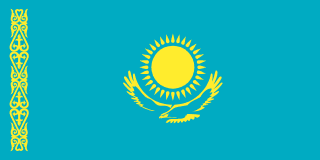
This flag has the highest proportion of teal of any flag in Flagpie, at 92%.
Kazakhstan's name combines 'Kazakh,' the name of the country's dominant ethnic group possibly meaning 'free' or 'wanderer' in old Turkic, with the Persian suffix 'stan,' meaning 'land of.'
Landscape: The largest landlocked country in the world, dominated by vast steppe, with mountains along the eastern border and desert in the south.
Climate: Extreme continental, very cold winters and hot, dry summers.
Food: Beshbarmak, boiled meat served over wide noodles, is considered the national dish, tied to the country's nomadic herding history.
Astana became Kazakhstan's capital in 1997, replacing Almaty, in a deliberate move to shift the country's centre of gravity and encourage development of its northern regions, and was renamed Nur-Sultan for several years before reverting to Astana in 2022. With a population of around 1.4 million, it features striking, often unconventional modern architecture built rapidly after the capital relocation.
The golden eagle, tied to the same regional eagle-hunting tradition found in Mongolia, is closely associated with Kazakh identity, and the tulip, which actually originated in Central Asia before reaching the Netherlands, holds particular symbolic significance there.
Kazakh felt-making and yurt construction reflect the country's nomadic heritage, similar to Mongolia's traditions, and traditional Kazakh jewellery, often featuring silver and semi-precious stones, remains a significant craft export. Kazakh dombra playing, a two-stringed traditional instrument, remains central to the country's musical storytelling tradition, passed down through generations of performers.
The Baikonur Cosmodrome, the world's first and largest operational space launch facility, has been used for space launches since the Soviet era and remains active today, and the Charyn Canyon, sometimes compared to a smaller version of the Grand Canyon, is one of the country's most striking natural landscapes. Lake Balkhash, one of the largest lakes in Asia, is unusual for being part fresh water and part saline within the same body of water.
The saiga antelope, with its distinctive large nose, is native to Kazakhstan's steppe and has faced severe conservation pressure, and the country's mountainous regions support snow leopards.
Kazakhstan is majority Muslim, predominantly Sunni, with a significant Russian Orthodox Christian minority, reflecting the country's long history of both Turkic and Russian/Soviet influence.
Kazakhstan is a significant exporter of crude oil, uranium, of which it's the largest global producer, and various metals, with its economy heavily shaped by extensive natural resource wealth.
Independence Day on December 16th marks 1991, when Kazakhstan declared sovereignty following the collapse of the Soviet Union, and Nauryz, the Central Asian spring New Year shared with Iran and several neighbouring countries, is celebrated with particular enthusiasm as a symbol of renewal and traditional nomadic culture. Capital City Day on July 6th celebrates Astana specifically, reflecting the country's significant investment in its purpose-built capital. Kazakhstan's Constitution Day in August also marks the country's transition to its current governing framework.
Boxing and wrestling both hold significant places in Kazakh sporting culture, the country having produced numerous Olympic medallists in both disciplines. Traditional Kazakh equestrian sports, including kokpar, a competitive game involving horseback riders and a goat carcass, remain genuinely practised and celebrated as an expression of the country's nomadic heritage. Kazakh athletes have also achieved notable success in figure skating and gymnastics at recent international competitions.
Kazakhstan is a presidential republic, with a President holding substantial executive authority alongside a Prime Minister and bicameral parliament. The country was led by Nursultan Nazarbayev continuously from independence in 1991 until 2019, one of the longest tenures of any post-Soviet leader, and Kazakhstan has since undergone a gradual, carefully managed political transition. Kazakhstan's vast natural resource wealth has funded significant infrastructure development since independence.
Khan Tengri, on the border with Kyrgyzstan and China, is generally recognised as Kazakhstan's highest point at 7,010 metres, a dramatic marble-peaked mountain in the Tian Shan range. The Caspian Depression holds the lowest point at around 132 metres below sea level, among the lowest points in Asia.
There's no especially close match for Kazakhstan's flag, the sky-blue field with a golden sun and soaring eagle, bordered by a traditional ornamental pattern along the hoist, is distinctive enough as a combination that confusion with another national flag is essentially unheard of.
Designed by Shaken Niyazbekov.
Adopted in 1992 shortly after independence from the Soviet Union.
The largest landlocked country in the world, and home to the shrinking Aral Sea, once one of the four largest lakes on Earth.
Play today's Flagpie →© Flagpie 2026