
Asia
Jordan sits in the Middle East, bordered by Syria to the north, Iraq to the northeast, Saudi Arabia to the east and south, and Israel and the Palestinian territories to the west.
Jordan takes its name from the Jordan River, which forms part of its western border, a name with ancient Semitic roots referring to the river's descending flow toward the Dead Sea.
Landscape: Mostly desert plateau, with the Jordan Rift Valley (including the Dead Sea, the lowest point on Earth's land surface) along the western border.
Climate: Arid to semi-arid, hot dry summers and mild winters.
Food: Mansaf, lamb cooked in a fermented dried yoghurt sauce served over rice, is Jordan's national dish.
Amman has been inhabited for thousands of years under various names, including Philadelphia during the Roman period, and became capital of modern Jordan after the country's establishment in the 1920s. With a population of around 4 million, it's built across several hills, giving the city a distinctive rolling skyline.
The black iris is Jordan's national flower, found in the country's highlands, and the Arabian oryx, reintroduced after being hunted to extinction in the wild regionally, is closely associated with Jordan's conservation efforts.
Bedouin weaving and silverwork remain significant craft traditions in Jordan, particularly among communities in the country's desert regions, and mosaic art, with roots going back to Byzantine-era churches still found across the country, remains an actively practised craft. Jordanian sand art, layering coloured desert sand into intricate patterns inside glass bottles, has become a distinctly popular local craft sold widely to visitors.
Petra, an ancient city carved directly into rose-coloured rock by the Nabataeans over 2,000 years ago, is Jordan's most famous landmark and one of the New Seven Wonders of the World, alongside Wadi Rum, a dramatic desert landscape used as a filming location for numerous space and desert films.
The Arabian oryx has been successfully reintroduced to protected reserves in Jordan after going extinct in the wild, and the country's Dana Biosphere Reserve protects a significant range of desert and mountain habitats.
Jordan is majority Sunni Muslim, with a significant Christian minority, one of the larger Christian populations proportionally in the Arab world, and the country is home to a large Palestinian refugee and resident population. Jordan has also played a significant regional diplomatic role given its position bordering Israel, the West Bank, Syria, and Iraq, making stability there a consistent regional priority.
Jordan is a significant exporter of potash and phosphates, both mined from the Dead Sea region, alongside pharmaceuticals and textiles.
Independence Day on May 25th marks 1946, when Jordan gained full sovereignty from British administration, celebrated with military parades and public festivities. Eid al-Fitr and Eid al-Adha are both major holidays given Jordan's Muslim population, and King Abdullah II's birthday and accession anniversary are also marked as public holidays, reflecting the monarchy's central role in Jordanian national identity. Christmas is also officially recognised given Jordan's significant Christian minority, one of the more established Christian communities in the Arab world.
Football holds the largest domestic following in Jordan, and taekwondo has produced the country's most significant individual Olympic success, Jordan's first ever Olympic medal coming in the sport in 2016. Horse riding and falconry both carry deep cultural roots tied to the country's Bedouin desert heritage. Jordan has also become a notable regional host for triathlon and endurance events given its varied desert and mountain terrain.
Jordan is a constitutional monarchy, with the King holding substantial executive authority, including over foreign policy and the military, alongside an elected House of Representatives and appointed Senate handling legislation. The Hashemite royal family, which claims direct descent from the Prophet Muhammad, has ruled Jordan since the country's founding in the 1920s.
Jabal Umm al Dami, in the country's south, is Jordan's highest point at 1,854 metres. The Dead Sea, shared with Israel, holds the lowest point at around 430 metres below sea level, the lowest point on Earth's land surface and continuing to drop further as the sea shrinks each year.
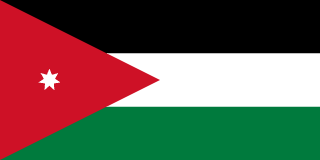
The United Arab Emirates, Palestine, and several other Arab nations all use the same red-black-white-green Pan-Arab colour combination Jordan does, tracing back to the 1916 Arab Revolt flag, and Jordan's specific white seven-pointed star set within the red triangle at the hoist is what distinguishes it most clearly from Palestine's near-identical design, which lacks that star entirely.
A near-direct descendant of the 1916 Arab Revolt flag, adopted essentially unchanged in 1928, with a seven-pointed star added to the triangle.
Home to Petra, an entire city carved directly into rose-coloured rock, hidden from the wider world until 1812.
Play today's Flagpie →© Flagpie 2026