
Asia
Japan is an island nation in East Asia, sitting in the Pacific Ocean off the eastern coast of the Asian mainland, across the Sea of Japan from Korea and Russia.
Japan's name in Japanese, Nihon or Nippon, means roughly 'origin of the sun,' a reference to the country's position east of China, from where the phrase was originally coined. The English word 'Japan' likely reached Europe through Malay and Portuguese traders, who adapted it from older Chinese pronunciations of the same characters.
Landscape: A chain of mountainous islands, around 75% of the land is too rugged to build or farm on, which is why most of the population is packed into narrow coastal plains.
Climate: Varies enormously north to south, from snowy winters in Hokkaido to a humid subtropical climate in Okinawa, with a distinct rainy season across most of the country in early summer.
Food: Sushi, ramen, and tempura are the best known exports, though everyday Japanese cooking leans heavily on rice, miso, and seasonal vegetables.
Tokyo has been the seat of government since 1868, when Emperor Meiji moved the imperial court there from Kyoto, which had held the role for over a thousand years. At the time it was renamed from Edo, the name Tokyo itself simply means 'eastern capital.' With a population of around 14 million within the city proper, and closer to 37 million across the greater metropolitan area, it's the most populous urban area in the world. It's known as much for its density and technology as for how it layers centuries of history, imperial palaces, Edo-period temples, alongside some of the most futuristic city infrastructure anywhere.
The cherry blossom, or sakura, is Japan's de facto national flower, prized for how briefly it blooms each spring, a deliberate symbol of life's fleeting beauty rather than in spite of it. The chrysanthemum is the official emblem of the imperial family specifically. The green pheasant is the national bird, native only to the Japanese archipelago.
The kimono is Japan's traditional national dress, a wrapped garment worn with a broad sash called an obi, its form largely settled by the Edo period after evolving from earlier Chinese-influenced court dress. Beyond clothing, Japan has a deep tradition of specialist crafts, including pottery, lacquerware, and swordsmithing, many passed down through family workshops for generations and still practiced according to centuries-old technique.
Mount Fuji, an active volcano and Japan's tallest peak, is the country's most recognisable natural landmark and a UNESCO World Heritage Site. Kyoto alone holds thousands of temples and shrines from its era as imperial capital, and Hiroshima's Peace Memorial stands as one of the most visited sites connected to the Second World War.
The Japanese macaque, often called the snow monkey, is famous for bathing in hot springs during winter in the country's mountainous regions, one of the few primates adapted to such cold climates. The red-crowned crane, a symbol of luck and longevity in Japanese culture, is found in the wetlands of Hokkaido.
Shinto and Buddhism are Japan's two major religious traditions, often practised alongside each other rather than exclusively, many Japanese people observe Shinto rituals for birth and marriage and Buddhist rites for funerals. A large share of the population identifies with no organised religion in everyday life, even while these traditions remain culturally significant.
Japan is one of the world's largest exporters of automobiles and automotive parts, alongside electronics, machinery, and precision instruments. It imports the majority of its energy needs, since it has very limited domestic oil and gas reserves.
Golden Week, a cluster of four national holidays running from late April into early May, is Japan's biggest travel period, when most workers stretch a handful of paid leave days into a full week off. Coming-of-Age Day each January celebrates everyone turning 20 that year, marked with formal kimono and hakama worn specifically for the occasion, and Obon in mid-August is a Buddhist tradition honouring ancestors, when many people return to their hometowns.
Sumo is Japan's national sport, with roots in Shinto ritual stretching back well over a thousand years, though baseball is genuinely more widely played and watched day to day, having taken hold during the American occupation era and never let go. Japan has also become a genuine world power in gymnastics and judo, the latter having originated there in the late 19th century.
Japan is a parliamentary constitutional monarchy, with the Emperor serving a purely ceremonial role and real political power held by the Prime Minister and the National Diet, Japan's bicameral parliament. The Liberal Democratic Party has governed for nearly all of the post-war period, making Japan one of the more stable one-party-dominant democracies in the world.
Mount Fuji, an active stratovolcano last erupting in 1707, is Japan's highest point at 3,776 metres, and remains snow-capped for much of the year despite sitting relatively close to Tokyo. The lowest point is the floor of Hachirogata, a former lake basin that was drained and reclaimed for farmland, sitting around 4 metres below sea level.
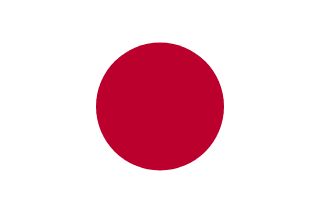
Bangladesh's flag is the one most likely to trip people up, both use a simple circle set against a plain background, though Bangladesh's is red on green rather than red on white, and positioned slightly off-centre rather than dead centre. Palau's flag uses a similarly simple single-circle design too, but in yellow on blue, different enough in colour that confusion is less likely. Beyond those, Japan's flag is genuinely distinctive, there's no other flag in the world with quite the same stark, minimal red-circle-on-white treatment.
The red sun disc design (Hinomaru) has represented Japan informally for centuries, but it was only legally adopted as the official national flag in 1999.
Has more than 6,850 islands, and one of the longest and most intricate coastlines on Earth.
Play today's Flagpie →© Flagpie 2026