
Asia
Iraq sits in the Middle East, bordered by Turkey to the north, Iran to the east, Kuwait and Saudi Arabia to the south, and Jordan and Syria to the west, home to the ancient region of Mesopotamia.
Iraq's name has ancient roots, likely derived from the historic city of Uruk, one of the earliest cities in the world, located in the region and considered a birthplace of writing and urban civilisation itself.
Landscape: Dominated by the Tigris and Euphrates river plains, with desert to the west and the Zagros Mountains along the northeastern border.
Climate: Mostly arid to semi-arid, extremely hot summers and mild winters.
Food: Masgouf, grilled river fish, is widely considered a national dish, alongside a strong tradition of rice and stewed meat dishes.
Baghdad was founded in 762 AD by the Abbasid Caliphate specifically to serve as their new capital, quickly growing into one of the largest and most intellectually significant cities in the world during the Islamic Golden Age. With a population of around 8 million, it remains Iraq's political and cultural centre despite decades of conflict having significantly damaged much of its historic infrastructure.
The golden eagle, known as the Eagle of Saladin, appears on Iraq's coat of arms, a symbol shared with Egypt and tied to the 12th-century Muslim leader famous for retaking Jerusalem during the Crusades.
Iraqi metalwork and calligraphy trace back to the Islamic Golden Age, when Baghdad was a centre of scholarship and craft production, and traditional Marsh Arab reed architecture in southern Iraq represents one of the oldest continuous building traditions in the world.
The ancient city of Babylon, home to the legendary (though not archaeologically confirmed) Hanging Gardens, and the Great Mosque of Samarra, with its distinctive spiralling minaret, are both significant historic sites reflecting Iraq's role as cradle of some of the earliest civilisations.
The Mesopotamian Marshes in southern Iraq, partially drained under Saddam Hussein's government and since restored, support significant bird populations and are considered one of the possible locations for the biblical Garden of Eden in local tradition.
Iraq is majority Muslim, split between Shia and Sunni populations, with a historic Christian minority and Kurdish population in the north maintaining distinct language and cultural traditions.
Iraq holds some of the largest oil reserves in the world, and crude oil exports form the overwhelming majority of the country's export revenue and government income.
Iraq's national holiday calendar has shifted repeatedly alongside its political changes over recent decades, though Army Day on January 6th, marking the founding of the modern Iraqi military in 1921, has remained a consistent fixture. Eid al-Fitr and Eid al-Adha are both major holidays given Iraq's Muslim population, and Ashura, commemorating the martyrdom of Imam Hussein, is observed with particular solemnity and significant public processions given Iraq's large Shia population. Nowruz is also celebrated by Iraq's Kurdish population, marking the arrival of spring with bonfires and traditional dress.
Football holds the largest domestic following in Iraq by a wide margin, the national team's surprise 2007 Asian Cup victory, achieved despite the country being in the midst of severe internal conflict at the time, remaining one of the most emotionally significant moments in modern Iraqi sporting history. Weightlifting has also historically produced notable Iraqi competitors at the international level.
Iraq is a federal parliamentary republic, with a largely ceremonial President as head of state and a Prime Minister holding real executive power, accountable to a single-chamber Council of Representatives. The country's current constitutional system was established following the 2003 US-led invasion that removed Saddam Hussein from power, and Iraq's Kurdistan region in the north retains significant autonomous self-government.
Cheekha Dar, in Iraqi Kurdistan near the Iranian border, is Iraq's highest point at 3,611 metres. The lowest point sits at sea level along Iraq's very short coastline on the Persian Gulf, one of the shortest of any country with maritime access.
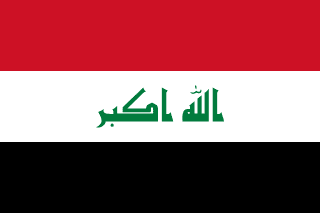
Egypt, Syria, and Yemen all use variations of the same red-white-black horizontal Pan-Arab tricolour Iraq does, tracing back to the 1916 Arab Revolt flag, and the countries are typically distinguished only by the number and arrangement of stars or central script, Iraq's own green Arabic script reading 'Allahu Akbar' being the specific detail that sets its current flag apart from its regional cousins.
Adopted in its current form in 2008, removing three stars that had represented the Ba'ath Party after the fall of Saddam Hussein's government, keeping the same red-white-black Pan-Arab base used since 1963.
Home to ancient Mesopotamia, widely regarded as the cradle of civilisation and the birthplace of writing.
Play today's Flagpie →© Flagpie 2026