
Europe
Iceland is an island nation in the North Atlantic Ocean, sitting just south of the Arctic Circle between Greenland and Norway.
Iceland's name, according to tradition, was given by an early Norse settler, Flóki Vilgerðarson, who reportedly named the island after seeing ice-choked fjords during a harsh winter, despite the country actually being considerably greener than its name suggests.
Landscape: Volcanic and geologically young, with glaciers, geysers, lava fields, and very little arable land.
Climate: Cool temperate, milder than its latitude suggests due to the Gulf Stream, with short summers and long winters.
Food: Fish, particularly cod and haddock, is central to Icelandic cooking, alongside skyr, a thick, yoghurt-like dairy product.
Reykjavík was Iceland's first permanent Norse settlement, traditionally dated to 874 AD, and its name means 'smoky bay,' likely referring to steam rising from the area's natural geothermal activity. With a population of around 140,000, it's the world's northernmost capital of a sovereign state.
The gyrfalcon, the largest falcon species in the world, is Iceland's national bird, and the mountain avens, a small white alpine flower, is the national flower.
The lopapeysa, a distinctive patterned wool sweater made from Icelandic sheep's wool, is a genuine national garment still widely worn, and Iceland has long traditions in fishing-related craft and knitting given the historical importance of both wool and the sea to the economy.
The Blue Lagoon, a geothermal spa formed partly by a nearby power plant, is one of Iceland's most visited sites, alongside Þingvellir National Park, where the world's oldest surviving parliament, the Althing, was established in 930 AD. Gullfoss, a powerful two-tiered waterfall, and the geothermal area of Geysir, which gave the English language the word 'geyser,' are both part of Iceland's popular Golden Circle tourist route.
Iceland is historically Lutheran, with the Church of Iceland remaining the largest religious body, though the country has become notably secular in practice, and old Norse mythology continues to hold cultural, if not religious, significance for many Icelanders. Iceland also has one of the highest rates of book publishing and readership per capita in the world, with a strong national tradition of storytelling dating back to the medieval Icelandic sagas.
Iceland is a significant exporter of seafood, particularly given its extensive fishing grounds, and aluminium, produced using the country's abundant and cheap geothermal and hydroelectric power.
Independence Day on June 17th marks 1944, when Iceland formally became a republic, separating fully from Denmark, and is celebrated with parades nationwide despite Iceland's small population making the celebrations feel genuinely community-scale rather than mass spectacle. Þorrablót in midwinter involves eating traditional preserved foods, some genuinely challenging by modern tastes, as a deliberate connection to the country's harsh historical survival heritage. Sjómannadagurinn, Seamen's Day in early June, honours Iceland's historic fishing industry with harbour festivities in coastal towns nationwide.
Handball is treated with outsized national pride in Iceland relative to its tiny population, the men's team having won an Olympic silver medal in 2008, a genuinely remarkable achievement for a country of Iceland's size. Football has also drawn significant recent attention following the national team's surprise run to the Euro 2016 quarterfinals, and swimming holds deep cultural roots given the country's abundant geothermal pools.
Iceland is a parliamentary republic, with a largely ceremonial President as head of state and a Prime Minister holding real executive power, accountable to the Althing, widely considered the oldest surviving parliament in the world, first established in 930 AD. The country has no standing military of its own, relying instead on international defence arrangements, a distinctive feature among modern nation-states. Iceland elected the world's first directly elected female head of state, Vigdís Finnbogadóttir, in 1980, a genuinely historic milestone.
Hvannadalshnúkur, part of the Öræfajökull volcano, is Iceland's highest point at 2,110 metres, sitting beneath the country's largest glacier. The lowest point sits at sea level along Iceland's dramatic, fjord-lined coastline.
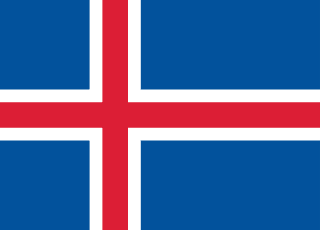
Norway's flag is Iceland's closest match by a wide margin, both use the same red-white-blue Nordic cross combination, differing only in exact proportions, making the two genuinely easy to mix up without a direct side-by-side comparison. Denmark, Sweden, and Finland all share the same underlying cross shape too, in different colour pairings, part of the same shared Nordic design tradition.
Designed by Matthías Þórðarson.
Adopted in 1915 while still in union with Denmark, formally became the flag of a fully independent Iceland in 1944.
Sits directly on the Mid-Atlantic Ridge, making it one of the most volcanically active places on Earth despite its small size.
Play today's Flagpie →© Flagpie 2026