
North America
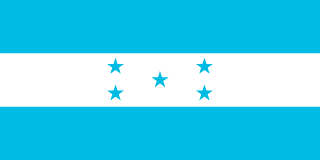
Honduras sits in Central America, bordered by Guatemala to the west, El Salvador to the southwest, and Nicaragua to the southeast, with coastlines on both the Caribbean Sea and the Pacific Ocean's Gulf of Fonseca.
Honduras's name means 'depths' in Spanish, reportedly given by Christopher Columbus after his ships encountered deep coastal waters along the country's Caribbean coastline during his fourth voyage.
Landscape: Mostly mountainous, with coastal lowlands on the Caribbean and Pacific sides and the Bay Islands offshore.
Climate: Tropical along the coasts, more temperate in the mountainous interior.
Food: Baleadas, a folded flour tortilla filled with beans, cheese, and cream, is a widely loved everyday food.
Tegucigalpa was founded in 1578 as a Spanish mining settlement, its name possibly derived from an Indigenous phrase referring to silver hills, reflecting the area's early mining significance. With a population of around 1.1 million, it became Honduras's capital in 1880, and its hilly terrain has made modern urban expansion notably challenging.
The scarlet macaw, a strikingly colourful parrot, is Honduras's national bird, and the rosa de San Sebastián, a large decorative flower, is the national flower.
Honduran Lenca pottery, using techniques passed down for generations by the Indigenous Lenca people, and Garifuna craft traditions along the Caribbean coast, including basket weaving and traditional cassava bread preparation tools, remain significant living traditions.
Copán, a major ancient Maya city known especially for its detailed carved stelae and hieroglyphic staircase, is Honduras's most significant archaeological site and a UNESCO World Heritage Site.
The Bay Islands, off Honduras's Caribbean coast, sit along the Mesoamerican Barrier Reef, the second-largest coral reef system in the world, supporting whale sharks and extensive marine biodiversity. Honduras's cloud forests support the resplendent quetzal and significant amphibian diversity, though both face pressure from ongoing deforestation.
Honduras is majority Christian, split between Catholic and growing evangelical Protestant traditions, and the country's population includes a significant Garifuna community along the Caribbean coast, descended from shipwrecked and escaped enslaved Africans who blended with Indigenous Caribbean populations. Honduras is often cited among the Central American countries with the highest emigration rates, driven partly by economic and security challenges.
Honduras is a significant exporter of coffee and bananas, alongside textiles, with the country historically closely associated with the banana trade that gave rise to the term 'banana republic.'
Independence Day on September 15th, shared with the rest of Central America, marks 1821, celebrated with student parades nationwide. Given Honduras's significant Catholic population, Semana Santa (Holy Week) before Easter is marked by elaborate processions, and Garifuna Settlement Day, celebrated particularly along the Caribbean coast, honours the arrival and heritage of Afro-Indigenous Garifuna communities. Honduras's Morazán Day in October honours a key 19th-century Central American unionist leader.
Football holds the largest domestic following in Honduras by a wide margin, the national team's multiple World Cup qualifications remaining a significant source of national sporting pride. Boxing has also produced notable Honduran competitors at the international level. Honduran athletics has grown through increased Central American regional competition.
Honduras is a presidential republic, with a President serving as both head of state and government. The country has experienced significant political instability, including a controversial 2009 coup that removed a sitting president, and Honduras has more recently grappled with significant gang violence and one of the highest emigration rates in Central America. Honduras's economy relies significantly on coffee exports and garment manufacturing.
Cerro Las Minas is Honduras's highest point at 2,870 metres. The lowest point sits at sea level along Honduras's coastlines on both the Caribbean and, briefly, the Pacific. Honduras's mountainous terrain covers much of the country, with narrower coastal plains along both its coastlines.
El Salvador, Nicaragua, and Guatemala all use variations of the same blue-white-blue tricolour tracing back to the former United Provinces of Central America, and Honduras's own five blue stars scattered across the central white band, representing the five founding nations, is what most clearly distinguishes it from its regional neighbours' differently arranged versions of the same shared design tradition. Honduras's five stars specifically distinguish it from El Salvador's differently designed coat of arms on a similar base tricolour.
Based on the flag of the United Provinces of Central America, adopted in its current form in 1866.
One of the top five coffee-producing countries in the world.
Play today's Flagpie →© Flagpie 2026