
South America
Guyana sits on the northern coast of South America, bordered by Venezuela to the west, Brazil to the south, and Suriname to the east, with the Atlantic Ocean along its northern edge. Its name comes from an Indigenous word meaning 'land of many waters.'
Guyana's name comes from an Indigenous word meaning 'land of many waters,' reflecting the country's extensive network of rivers, and was adopted upon independence from Britain in 1966, replacing the colonial name British Guiana.
Landscape: A narrow coastal plain (where most of the population lives) rising to dense rainforest and the Guiana Highlands further inland.
Climate: Tropical, hot and humid with two wet seasons.
Food: Pepperpot, a slow-cooked meat stew flavoured with cassareep (a cassava extract), is the national dish, traditionally eaten at Christmas.
Georgetown was founded in 1781 and named after King George III, growing from a Dutch and later British colonial settlement into Guyana's capital. With a population of around 235,000, it sits below sea level and is protected by an extensive system of Dutch-built sea walls and canals, similar to the Netherlands' own coastal defences.
The Victoria amazonica, an enormous water lily with leaves that can grow over two metres wide, is Guyana's national flower, and the canje pheasant, a distinctive prehistoric-looking bird, is the national bird.
Guyanese Indigenous communities, including the Wapishana and Macushi, maintain traditional basket weaving and hammock-making crafts using balata rubber and other forest materials, and Guyanese woodworking, given the country's extensive rainforest, remains a significant traditional and commercial craft. Guyanese Indigenous pottery and cassava-processing tools reflect techniques used continuously for centuries by communities living along the country's interior rivers.
Kaieteur Falls, one of the most powerful single-drop waterfalls in the world, plunging over 220 metres, is Guyana's most significant natural landmark, sitting largely undeveloped within a national park of the same name.
Guyana's rainforest, among the most intact in the world given its low population density, supports jaguars, giant river otters, and the harpy eagle, one of the largest and most powerful raptors on Earth.
Guyana is religiously diverse, with significant Christian, Hindu, and Muslim populations reflecting a history of African, Indian, and Indigenous settlement, making it one of the more religiously mixed countries in South America.
Guyana has rapidly become a major oil exporter following significant offshore discoveries in the 2010s, alongside gold, bauxite, and rice, with oil revenue transforming what was once one of South America's poorest economies.
Independence Day on May 26th marks 1966, when Guyana gained sovereignty from British colonial rule. Given Guyana's significant Hindu, Muslim, and Christian populations, the country officially recognises major holidays across all three faiths, including Diwali, Eid, and Christmas, reflecting its genuinely multicultural population shaped by indentured labour migration history. Guyana's Republic Day in February marks the country's 1970 transition to a full republic.
Cricket holds the largest domestic following in Guyana by a wide margin, the country having contributed players to the historically dominant West Indies team despite being geographically part of South America rather than the Caribbean proper. Athletics has also produced notable Guyanese competitors at the international level. Guyanese boxing has also produced notable competitors at the international level.
Guyana is a semi-presidential republic, with a President holding substantial executive authority alongside a Prime Minister and single-chamber National Assembly. The country's significant recent offshore oil discoveries have rapidly transformed its economy, and Guyana's long-standing border dispute with Venezuela over the oil-rich Essequibo region has become an increasingly prominent international issue. Guyana's rapid oil-driven economic growth has made it one of the fastest-growing economies in the world in recent years.
Mount Roraima, shared with Venezuela and Brazil, is Guyana's highest point at 2,772 metres, a dramatic flat-topped tepui mountain believed to have inspired Arthur Conan Doyle's novel The Lost World. The lowest point sits at sea level along Guyana's coastline, much of which lies below sea level and is protected by sea walls. Guyana's terrain ranges from coastal lowlands, much of it below sea level, to dense interior rainforest and highland plateau.
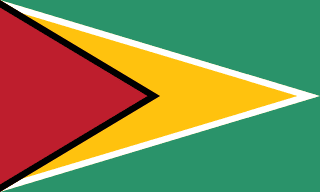
There's no especially close match for Guyana's flag, nicknamed 'The Golden Arrowhead,' the green field with a red triangle bordered by black and white outlines pointing inward from the hoist is a genuinely distinctive layout, designed by an American vexillologist, one of the few national flags designed by a non-citizen.
Designed by Whitney Smith.
Adopted in 1966 at independence, nicknamed 'The Golden Arrowhead,' designed by an American vexillologist, one of the few national flags designed by a non-citizen of the country.
One of the most densely forested countries in South America.
Play today's Flagpie →© Flagpie 2026