
Africa
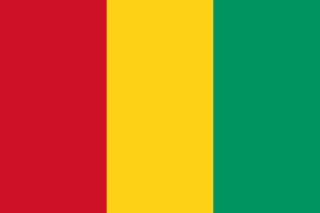
Guinea sits on the Atlantic coast of West Africa, bordered by Guinea-Bissau, Senegal, and Mali to the north, Ivory Coast to the southeast, and Liberia and Sierra Leone to the south.
Guinea's name likely comes from a Berber word used by North African traders to refer to the land of Black Africans south of the Sahara, later adopted broadly by European powers for the wider West African coastal region.
Landscape: Includes a coastal plain, the Fouta Djallon highlands, savanna, and forested mountains in the southeast.
Climate: Tropical, with a pronounced wet season along the coast and drier conditions further inland.
Food: Riz gras, rice cooked with a rich tomato, meat, and vegetable sauce, is widely eaten across the country.
Conakry was founded by the French in the late 19th century on a small island connected to the mainland, chosen for its port potential. With a population of around 2 million, it remains Guinea's dominant political and economic centre, though its infrastructure has struggled to keep pace with rapid population growth.
The elephant appears on Guinea's coat of arms, and the country's flag colours, drawn directly from Ghana's in a Pan-African gesture of solidarity, remain a significant part of national symbolism.
Guinean djembe drumming and associated dance traditions, with roots in the historic Mali Empire, have become internationally significant, taught and performed well beyond West Africa today, and traditional Guinean textile weaving remains practised across the country's various ethnic communities. Traditional Guinean mask-making, particularly among the Baga people, produces some of the most distinctive ceremonial sculpture in West African art.
Mount Nimba, a UNESCO World Heritage Site shared with Ivory Coast and Liberia, protects a significant area of West African forest and grassland, and the Fouta Djallon highlands offer dramatic plateau scenery distinct from the country's coastal lowlands.
Mount Nimba is known for exceptional biodiversity, including a unique population of chimpanzees observed using stone tools, and viviparous toads that give birth to live young rather than laying eggs.
Guinea is overwhelmingly Muslim, and the country is home to several major ethnic groups, including the Fula, Mandinka, and Susu, each with distinct languages and cultural traditions.
Guinea holds some of the largest bauxite reserves in the world, the primary ore used to produce aluminium, and is one of the largest global exporters of the mineral, alongside gold.
Independence Day on October 2nd marks 1958, when Guinea became the first French African colony to gain full sovereignty, having voted to reject continued association with France entirely rather than accept a looser autonomous relationship other colonies chose. Given Guinea's overwhelmingly Muslim population, Eid al-Fitr and Eid al-Adha are both major national holidays. Guinea's Referendum Day in September marks the 1958 vote that led directly to independence from France.
Football holds the largest domestic following in Guinea by a wide margin, even without major recent international success to match. Traditional wrestling and drumming performances, the latter tied closely to Guinea's globally influential djembe drumming tradition, both carry genuine cultural significance well beyond conventional sport. Guinean basketball has also produced players competing in European leagues.
Guinea is a presidential republic, though the country's political situation has been in flux following a 2021 military coup, with a transitional government currently in place. Guinea has experienced significant political instability across much of its post-independence history, including decades of authoritarian rule under its first president. Guinea holds some of the largest bauxite reserves in the world, central to global aluminium production.
Mont Nimba, shared with Ivory Coast and Liberia, is Guinea's highest point at 1,752 metres, part of a range recognised by UNESCO for exceptional biodiversity. The lowest point sits at sea level along Guinea's Atlantic coastline. Guinea's varied terrain includes coastal lowlands, the Fouta Djallon highlands, and forested mountains in the southeast.
Ghana's flag directly inspired Guinea's own red-yellow-green vertical tricolour, adopted deliberately in tribute to Ghanaian support for Guinea's independence movement, and Mali's flag uses the identical three colours in the same vertical arrangement too, making the family of West African flags sharing this palette genuinely easy to mix up without a careful look. Guinea's plain, unadorned stripes make it the simplest version of the shared Ghana-inspired West African colour family.
Adopted in 1958 at independence, its colours directly inspired by Ghana's flag, in tribute to Ghanaian support for Guinea's independence movement.
Sometimes called the 'water tower of West Africa,' since several major rivers all originate within its borders.
Play today's Flagpie →© Flagpie 2026