
Africa
Guinea-Bissau is a small country on the Atlantic coast of West Africa, bordered by Senegal to the north and Guinea to the south and east.
Guinea-Bissau takes its name from the wider Guinea region of West Africa, with 'Bissau,' its capital, added to distinguish it from neighbouring Guinea after both gained independence around the same time in the early 1970s.
Landscape: A low-lying coastal country with mangrove swamps, the Bijagós Archipelago offshore, and savanna further inland.
Climate: Tropical, hot and humid with a pronounced wet season.
Food: Jollof rice and a range of fish stews reflect Guinea-Bissau's West African coastal food traditions.
Bissau was founded by the Portuguese in 1687 as a fortified trading post on the Geba River estuary, and became the country's capital in 1941, replacing Bolama. With a population of around 500,000, it remains the country's dominant port, administrative, and military centre, home to sites tied to the independence movement led by Amílcar Cabral.
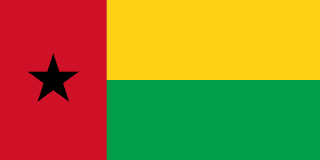
The black star, echoing the Pan-African symbolism used by Ghana, appears on Guinea-Bissau's flag, directly tied to the country's independence movement and its solidarity with wider African liberation struggles of the 1960s and 70s.
Traditional Bissau-Guinean mask-making and wood carving, particularly among the Bijagós people of the country's offshore archipelago, reflect distinct spiritual and ceremonial traditions tied to the islands' relative isolation.
The Bijagós Archipelago, a UNESCO Biosphere Reserve made up of dozens of islands, is Guinea-Bissau's most significant natural and cultural landmark, home to communities that have preserved distinct traditional governance and matrilineal customs.
The Bijagós Islands support one of the largest remaining populations of saltwater hippopotamuses in West Africa, an unusual adaptation for the species, alongside significant sea turtle nesting sites. Manatees are occasionally sighted in the country's coastal river estuaries.
Guinea-Bissau is religiously mixed, with Islam, Christianity, and traditional African beliefs all significantly represented, and the country is home to numerous ethnic groups including the Balanta, Fula, and Mandinka, each with distinct languages and customs. Traditional matrilineal inheritance customs on the Bijagós Islands remain distinct from mainland practices, with women historically holding significant social and property authority.
Guinea-Bissau is a significant exporter of cashew nuts, which form the overwhelming majority of the country's export revenue, making its economy particularly vulnerable to fluctuations in global cashew prices.
Independence Day on September 24th marks 1973, when Guinea-Bissau unilaterally declared sovereignty from Portugal during an ongoing liberation war, with full international recognition following in 1974. Amílcar Cabral Day on January 20th honours the independence movement leader assassinated shortly before the country's sovereignty was achieved, a figure of shared significance with neighbouring Cabo Verde. Guinea-Bissau's Colonial Repression Martyrs Day in August honours victims of a 1959 dockworkers' massacre under Portuguese rule.
Football holds the largest domestic following in Guinea-Bissau, the national team's qualification for the 2017 Africa Cup of Nations, its first ever major tournament appearance, treated as a landmark achievement for one of West Africa's smaller and less internationally prominent footballing nations. Bissau-Guinean athletics has grown through regional West African competition participation.
Guinea-Bissau is a semi-presidential republic, splitting executive authority between a directly elected President and a Prime Minister accountable to a single-chamber National People's Assembly. The country has experienced significant political instability since independence, including numerous coups and attempted coups, among the highest counts of any nation relative to its history. The country's economy relies heavily on cashew nut exports, making it particularly vulnerable to global price swings. Guinea-Bissau remains among the world's poorest nations by GDP per capita, a significant ongoing development challenge.
Guinea-Bissau's highest point sits at around 300 metres in the country's eastern highlands near the Guinea border. The lowest point sits at sea level along Guinea-Bissau's coastline and the Bijagós Archipelago. Guinea-Bissau's terrain is generally low-lying, including significant mangrove coastline and the Bijagós Archipelago.
Ghana's flag directly inspired Guinea-Bissau's own red-yellow-green colour combination, another Pan-African tribute, and Guinea-Bissau's own black star at the hoist, drawn from the same Black Star Line symbolism found on Ghana's flag, is what most clearly distinguishes it from its West African cousins sharing similar colour palettes. Guinea-Bissau's black star specifically echoes Ghana's own Black Star Line symbolism directly.
Adopted in 1973 during the fight for independence from Portugal, directly modelled on Ghana's flag, another Pan-African tribute.
Home to the Bijagós Archipelago, a UNESCO Biosphere Reserve of more than 80 islands.
Play today's Flagpie →© Flagpie 2026