
North America
Guatemala sits at the northern end of Central America, bordered by Mexico to the north and west, Belize to the northeast, and Honduras and El Salvador to the southeast.
Guatemala's name likely comes from a Nahuatl word meaning 'place of many trees,' reflecting the region's dense forest cover as seen by early Spanish-allied Nahuatl-speaking soldiers during the conquest.
Landscape: Mountainous and volcanic through much of the country, with tropical lowlands and rainforest in the north (Petén) and coastline on both the Pacific and Caribbean.
Climate: Varies by altitude, tropical in the lowlands, temperate in the highlands.
Food: Pepián, a spiced meat stew, is widely considered a national dish, reflecting a strong Maya culinary influence.
Guatemala City became the country's capital in 1776, after earlier capitals were destroyed by earthquakes, chosen for its comparatively safer location. With a population of around 3 million across the metropolitan area, it remains Central America's largest city.
The resplendent quetzal, a strikingly colourful bird once sacred to the Maya and Aztecs, is Guatemala's national bird, so significant that the country's currency is named after it. The white nun orchid is the national flower.
Guatemalan textile weaving, particularly using a backstrap loom technique that predates Spanish colonisation, remains a living Maya tradition, with specific patterns and colours historically identifying a weaver's home village. Guatemalan worry dolls, small handmade figures traditionally given to children to help ease anxiety before sleep, are a distinctive folk craft exported internationally.
Tikal, a massive ancient Maya city with temples rising above the surrounding rainforest canopy, is Guatemala's most significant archaeological site, and Antigua Guatemala, a well-preserved former colonial capital, is a UNESCO World Heritage Site. Lake Atitlán, surrounded by volcanoes and traditional Maya villages, is widely considered one of the most beautiful lakes in the world.
The resplendent quetzal survives in Guatemala's cloud forests, and the country's rainforests support jaguars, howler monkeys, and significant biodiversity shared with the wider Maya Forest region spanning into Mexico and Belize.
Guatemala is majority Roman Catholic, though evangelical Christianity has grown substantially in recent decades, and the country has one of the largest Indigenous Maya populations in the Americas, with numerous distinct Maya languages still spoken today. Maya calendar traditions and ceremonial practices remain genuinely observed by many Indigenous communities alongside mainstream Catholic and evangelical worship.
Guatemala is a significant exporter of coffee, sugar, and bananas, and remains one of the largest coffee producers in Central America.
Independence Day on September 15th, shared with the rest of Central America, marks 1821, celebrated with torch relays and parades nationwide. Revolution Day on October 20th commemorates a 1944 uprising that ended a long dictatorship and ushered in a decade of significant democratic and social reform, a period held in particular regard in Guatemalan historical memory. All Saints' Day in Sumpango and Santiago Sacatepéquez features enormous handmade kites flown to communicate with departed spirits.
Football holds the largest domestic following in Guatemala by a wide margin, even without major recent international success to match the country's enthusiasm for the sport. Traditional Maya ballgames, precursors to modern sport played for over a thousand years before Spanish colonisation, remain culturally significant and are occasionally re-enacted at cultural festivals. Guatemalan cycling has grown significantly in domestic popularity, aided by the country's mountainous, climb-heavy terrain.
Guatemala is a presidential republic, with a President serving as both head of state and government, elected for a single four-year term. The country experienced a prolonged and brutal civil war lasting from 1960 to 1996, whose legacy, including significant violence against Indigenous Maya communities, continues to shape Guatemalan politics and society today. Guatemala's Congress remains a single chamber, with representatives elected through a mix of national and departmental constituencies.
Volcán Tajumulco, an inactive volcano, is Guatemala's highest point at 4,220 metres, the highest peak in Central America. The lowest point sits at sea level along Guatemala's coastlines on both the Pacific and the Caribbean.
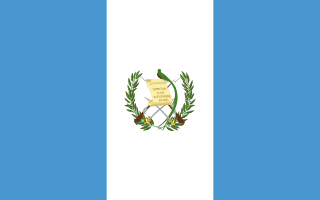
El Salvador and Honduras both use variations of the same blue-white-blue horizontal tricolour Guatemala's is related to, all tracing back to the shared flag of the former United Provinces of Central America, though Guatemala's own vertical blue-white-blue arrangement with its detailed central emblem, rather than the horizontal layout used by several of its neighbours, sets it apart structurally.
Based on the flag of the United Provinces of Central America, adopted in its current simplified two-stripe form in 1871.
Home to the ancient Maya civilisation, and one of the world's largest producers of coffee and cardamom.
Play today's Flagpie →© Flagpie 2026