
Africa
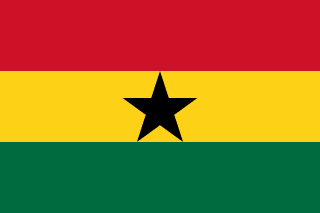
Ghana sits on the Gulf of Guinea coast of West Africa, bordered by Ivory Coast to the west, Burkina Faso to the north, and Togo to the east.
Modern Ghana took its name from the medieval Ghana Empire, which lay further north and west of the current country's borders, chosen deliberately after independence in 1957 as a way of connecting the new nation to a powerful pre-colonial African history, rather than reflecting direct geographic continuity.
Landscape: Coastal plains in the south, forested hills in the centre, and savanna further north.
Climate: Tropical, with a wetter climate in the south and a drier, more arid climate toward the north.
Food: Jollof rice is a point of good-natured national pride and regional rivalry, alongside fufu served with a range of soups and stews.
Accra grew from a cluster of small fishing and trading settlements into Ghana's capital, formally taking on the role in 1877 under British colonial administration, replacing Cape Coast. With a population of around 2.6 million in the city itself, it became the country's dominant political and commercial centre partly due to its coastal trading position, which had already made it valuable to European traders for centuries before.
The black star, drawn from Marcus Garvey's Black Star Line shipping company, is Ghana's most significant national symbol, appearing on both the flag and in the nickname of the national football team, the Black Stars. The grey parrot is one of the country's most recognised native birds, though heavy trapping for the pet trade has significantly reduced its wild population.
Kente cloth, a brightly patterned, hand-woven textile historically associated with Ashanti royalty, is Ghana's best-known craft export, each pattern and colour combination traditionally carrying specific symbolic meaning. Adinkra symbols, a set of visual icons representing proverbs and concepts, are another distinctly Ghanaian design tradition, printed onto cloth and used decoratively.
Cape Coast Castle and Elmina Castle, both built centuries ago and used during the transatlantic slave trade, are now UNESCO World Heritage Sites and significant sites of historical memory and remembrance. Lake Volta, formed by damming the Volta River, is one of the largest reservoirs by surface area in the world.
Mole National Park, Ghana's largest protected wildlife area, is home to elephants, antelope, and baboons, alongside significant birdlife. Ghana's forest regions also support several primate species, including the endangered white-naped mangabey.
Ghana is majority Christian, with significant Muslim and traditional African religious minorities, and is often cited as one of the more religiously tolerant countries in the region. It's home to numerous ethnic groups, including the Akan, Ewe, and Ga, each with distinct languages and cultural traditions.
Ghana is one of the world's largest exporters of cocoa, alongside gold and, more recently, oil, which was discovered offshore in commercial quantities in 2007 and has become an increasingly significant part of the economy.
Independence Day on March 6th marks 1957, when Ghana became the first sub-Saharan African country to gain independence from colonial rule, a milestone that carries significance well beyond Ghana's own borders. Republic Day on July 1st marks the 1960 transition to a full republic, and Homowo, a harvest festival celebrated by the Ga people, remains an important traditional celebration in the Accra region.
Football is Ghana's dominant sport by a wide margin, the national team, nicknamed the Black Stars, having built a strong reputation across multiple World Cup appearances, and Ghanaian boxers have historically punched well above their weight at the international level too, producing several world champions.
Ghana is a presidential republic and is widely regarded as one of West Africa's more stable democracies, with a President serving as both head of state and government, elected for four-year terms with a two-term limit. The country has had several peaceful transfers of power between political parties since returning to civilian rule in 1992, a genuinely notable achievement given the region's broader political history. Ghana's Ashanti and other traditional kingdoms retain ceremonial authority and genuine local influence alongside the modern republic, a dual system common across much of West Africa.
Mount Afadjato, in the country's Volta Region, is Ghana's highest point at 885 metres, modest by global standards but locally significant as a popular hiking destination. The lowest point sits at sea level along Ghana's Atlantic coastline.
Ethiopia's flag uses the exact same green-yellow-red horizontal layout as Ghana, and it's not a coincidence, Ghana deliberately adopted Ethiopia's colours upon independence as a tribute, since Ethiopia was the only African nation never colonised. Guinea-Bissau and several other West African nations copied Ghana's own flag in turn, in the same spirit, meaning the whole colour family shows up repeatedly across the continent, usually distinguished only by whichever central emblem, or lack of one, each country adds.
Designed by Theodosia Okoh.
Adopted in 1957 at independence, briefly changed to swap gold for white between 1964 and 1966 under Kwame Nkrumah, then restored to Okoh's original design, which has remained unchanged since.
The first sub-Saharan African country to gain independence from colonial rule, in 1957.
Play today's Flagpie →© Flagpie 2026