
Asia
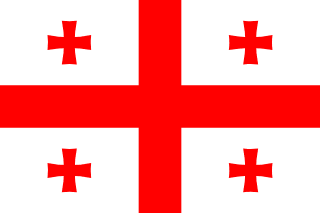
Georgia sits in the South Caucasus at the crossroads of Europe and Asia, bordered by Russia to the north, Azerbaijan to the east, Armenia and Turkey to the south, with a coastline on the Black Sea.
Georgia's English name likely derives from the Persian word for the region, though Georgians themselves call their country Sakartvelo, meaning 'land of the Kartvelians,' referring to the country's dominant ethnic and linguistic group.
Landscape: The Caucasus Mountains dominate the north, with fertile lowlands and a Black Sea coastline in the west.
Climate: Varies from subtropical along the Black Sea coast to alpine in the Caucasus Mountains.
Food: Khachapuri, a cheese-filled bread, is a genuine national obsession, alongside khinkali, spiced meat dumplings.
Tbilisi was founded in the 5th century AD, according to legend by a king who discovered hot springs there while hunting, giving the city its name, which means roughly 'warm place.' With a population of around 1.2 million, it sits at a historic crossroads between Europe and Asia, reflected in its layered architecture spanning Persian, Ottoman, Russian, and Soviet influence.
Saint George, the country's namesake in Georgian tradition (Sakartvelo relates differently, though the English name ties to him), appears on Georgia's flag and coat of arms, slaying a dragon, a widely recognised symbol of the country's Christian heritage.
Georgian wine-making, using traditional qvevri clay vessels buried underground, is recognised by UNESCO and considered among the oldest continuous winemaking traditions in the world, dating back over 8,000 years. Georgian polyphonic singing, a distinctive multi-part vocal style, is similarly UNESCO-recognised.
The cave city of Vardzia, carved into a cliffside in the 12th century, and the ancient churches of Mtskheta, Georgia's former capital and spiritual centre, are both UNESCO World Heritage Sites. The Georgian Military Highway, an ancient mountain route connecting Georgia to Russia through the Caucasus, remains a dramatic and historically significant travel corridor.
The Caucasus Mountains, which run through Georgia, support brown bears, lynx, and the endangered Caucasian leopard, and the region is considered one of the world's biodiversity hotspots.
Georgia is overwhelmingly Orthodox Christian, having adopted Christianity as a state religion in the early 4th century, among the earliest countries in the world to do so, and the Georgian Orthodox Church remains deeply woven into national identity.
Georgia is a significant exporter of wine, mineral water, and ferroalloys, with wine exports in particular carrying deep cultural as well as economic significance.
Independence Day on May 26th marks 1918, when Georgia briefly became an independent democratic republic before Soviet annexation, a date that also marks the country's later 1991 restoration of sovereignty following the Soviet Union's collapse. Saint George's Day, celebrated twice yearly given the saint's particular significance to the country that bears a version of his name in English, remains widely observed. Georgia's Mtskhetoba festival each October celebrates the ancient former capital's deep religious and historical significance.
Rugby holds a genuinely significant place in Georgian sporting culture, unusual for a country in this region, the national team having become one of the strongest rugby nations outside the sport's traditional heartlands. Wrestling and judo have also produced numerous Georgian Olympic medallists, reflecting a deep regional combat sport tradition shared across the Caucasus. Georgian basketball has also grown significantly in domestic popularity in recent years.
Georgia is a parliamentary republic, with a largely ceremonial President as head of state and a Prime Minister holding real executive power, accountable to a single-chamber parliament. The country's relationship with Russia has remained a defining and often difficult feature of its foreign policy, including a brief but significant 2008 war over the breakaway regions of South Ossetia and Abkhazia. Georgia has pursued closer integration with European institutions as a central foreign policy goal since independence.
Mount Shkhara, on the border with Russia, is Georgia's highest point at 5,193 metres, part of the dramatic Caucasus range. The lowest point sits at sea level along Georgia's Black Sea coastline.
There's no especially close match for Georgia's flag, the white field bearing a central red Saint George's Cross with four smaller red crosses in each quadrant is distinctive enough as a specific combination, this particular five-cross design, sometimes called the 'Five Cross Flag,' not closely replicated by any other national flag currently in use.
The 'Five Cross Flag' has medieval roots, was revived in 2004 after the Rose Revolution, replacing a simpler maroon-and-black flag used since Soviet-era independence.
Widely regarded as one of the birthplaces of wine, with evidence of winemaking dating back over 8,000 years.
Play today's Flagpie →© Flagpie 2026