
Africa
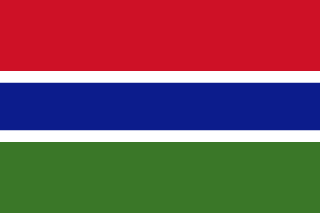
The Gambia is the smallest country on mainland Africa, a narrow strip of land following the Gambia River, almost entirely surrounded by Senegal except for its short Atlantic coastline.
The Gambia's name comes from the Gambia River, which runs the length of the country and forms the basis of its unusual, narrow geographic shape, with the river's own name possibly derived from a Mandinka word.
Landscape: A narrow strip of land following the Gambia River, almost entirely surrounded by Senegal.
Climate: Tropical, hot with a distinct wet and dry season.
Food: Domoda, a peanut-based stew usually made with meat and vegetables, is a widely eaten national dish.
Banjul has served as The Gambia's capital since British colonial times, founded in 1816 as a base to help suppress the transatlantic slave trade along the West African coast. With a population of around 32,000 within the city itself, it remains one of the smallest national capitals in Africa, with nearby Serekunda actually holding a considerably larger population.
The oil palm holds particular significance in Gambian tradition, tied historically to the country's economy, and traditional Gambian griot storytelling, shared with neighbouring Senegal, remains a significant living cultural institution.
Gambian batik textile dyeing and traditional wood carving are significant local crafts, and Gambian kora music, played on a traditional 21-string harp-lute, reflects deep West African griot musical tradition. Traditional Gambian tie-dye textile production remains a significant craft, particularly among women's cooperatives in rural communities.
The Kunta Kinteh Island and related sites along the Gambia River, connected to the transatlantic slave trade and made internationally known through Alex Haley's novel Roots, form a UNESCO World Heritage Site of significant historical memory.
The Gambia River supports significant hippopotamus and Nile crocodile populations, and the country's Abuko Nature Reserve, though small, protects a surprising diversity of forest wildlife for its size.
The Gambia is overwhelmingly Muslim, and the country's population reflects a mix of ethnic groups, including Mandinka, Fula, and Wolof, shared culturally and linguistically with neighbouring Senegal, which surrounds it almost entirely. The Gambia's status as mainland Africa's smallest country gives it an unusually close-knit national identity despite its ethnic diversity.
The Gambia's economy relies significantly on groundnuts (peanuts) and re-export trade through its port, alongside a tourism sector focused on its beaches and birdwatching along the Gambia River.
Independence Day on February 18th marks 1965, when The Gambia gained sovereignty from British colonial rule. Given The Gambia's overwhelmingly Muslim population, Eid al-Fitr and Eid al-Adha are both major national holidays, alongside a smaller Christian minority observing Christmas. The Gambia's Revolution Day, marking a past political transition, remains observed as a public holiday.
Football holds the largest domestic following in The Gambia by a wide margin, even without major international competitive success to match, and wrestling remains practised in traditional forms across various communities, tied to regional customs shared with neighbouring Senegal. Gambian athletics has grown through participation in regional West African competitions.
The Gambia is a presidential republic, with a President serving as both head of state and government. The country experienced 22 years of authoritarian rule under a single leader until a surprising 2016 election defeat led to a democratic transition, an outcome that was initially contested before international pressure secured the peaceful transfer of power. The Gambia's tourism industry, centred on its Atlantic beaches, forms a significant part of the small country's economy.
The Gambia's highest point sits at just 53 metres, an unnamed rise near the country's southeastern border, reflecting the country's narrow, low-lying geography following the Gambia River. The lowest point sits at sea level along The Gambia's short Atlantic coastline. The Gambia's entire territory follows the narrow course of the Gambia River, giving it an unusually elongated shape.
There's no especially close match for The Gambia's flag, the red-blue-green horizontal bands separated by thin white stripes, representing the sun, the Gambia River, and the country's agriculture respectively, are a distinctive combination, deliberately avoiding green as a dominant colour so as not to be confused with neighbouring Senegal's flag. The Gambia's red-blue-green combination is a deliberately distinct choice from Senegal's own green-yellow-red neighbour flag.
Adopted in 1965 upon independence from Britain, deliberately avoiding green so as not to be confused with neighbouring Senegal or Mali's flags of the time.
The smallest country on mainland Africa, almost entirely surrounded by Senegal.
Play today's Flagpie →© Flagpie 2026