
Africa
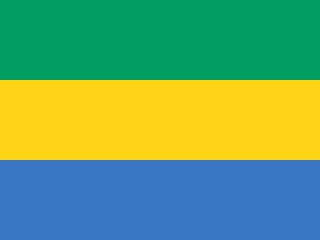
Gabon sits on the Atlantic coast of Central Africa, bordered by Equatorial Guinea and Cameroon to the north and the Republic of the Congo wrapping around its east and south.
Gabon's name comes from the Portuguese word 'gabão,' referring to a type of hooded coat, after early Portuguese sailors thought the shape of the Komo River estuary resembled the garment.
Landscape: More than 80% covered by dense equatorial rainforest, with a coastal plain along the Atlantic and a low interior plateau.
Climate: Tropical, hot and humid year-round with heavy rainfall.
Food: Nyembwe chicken, cooked in a sauce made from palm nut pulp, is a widely eaten traditional dish.
Libreville was founded in 1849 by the French as a settlement for freed and rescued enslaved people, and its name means 'free town' in French, reflecting these origins. With a population of around 800,000, it remains Gabon's dominant political and economic centre.
The black panther (a melanistic leopard) is Gabon's national animal, and the okoumé tree, historically central to the country's timber industry, holds particular economic and cultural significance.
Gabonese Fang mask-making, historically used in Bwiti spiritual ceremonies, is considered among the most significant traditions in Central African art, having influenced numerous 20th-century European artists after being exhibited in Europe. Traditional Gabonese Bwiti ceremonial music, featuring the mongongo harp, remains tied closely to the country's spiritual practices.
Lopé National Park, a UNESCO World Heritage Site, protects rainforest and savanna habitat with evidence of human occupation dating back tens of thousands of years, and Gabon's extensive coastline includes Loango National Park, known for surfing hippopotamuses and beach-visiting forest elephants.
Gabon holds one of the largest remaining forest elephant populations in Africa, and its network of national parks, covering around 11% of the country, protects one of the most intact rainforest ecosystems remaining on the continent.
Gabon is majority Christian, and the Bwiti spiritual tradition, involving the ceremonial use of the iboga plant, remains practised alongside Christianity by significant portions of the population, reflecting a genuine blending of belief systems. Gabon's relatively small population and significant oil wealth have given it one of the higher GDP per capita figures in mainland sub-Saharan Africa.
Gabon is a significant exporter of crude oil and manganese, with natural resources forming the overwhelming majority of the country's export economy despite its relatively small population.
Independence Day on August 17th marks 1960, when Gabon gained sovereignty from French colonial rule. Given Gabon's significant Christian population, Christmas and Easter are both widely observed, and the country's rich Bwiti spiritual tradition, involving ceremonial use of the iboga plant, remains practised alongside mainstream religious observance by many Gabonese. Gabon's Women's Day in April recognises the role of women in the country's social and economic life.
Football holds the largest domestic following in Gabon, the country having co-hosted the Africa Cup of Nations in both 2012 and 2017, notable achievements for a nation of Gabon's relatively small population. Basketball and athletics also draw modest domestic followings. Gabonese swimming has produced the country's first individual Olympic medal in recent Games.
Gabon is a presidential republic, with a President serving as both head of state and government. The country experienced a military coup in 2023 that ended over five decades of continuous rule by the same family, and Gabon's political system remains in a period of transition as a result. Gabon's oil wealth has given it one of the higher GDP-per-capita figures in mainland sub-Saharan Africa. Gabon's forest cover, among the highest percentages of any country, has driven growing eco-tourism interest. Gabon's small population relative to its resource wealth has historically given it a comparatively high income level for the region. Its rainforest cover remains among the most intact in all of Central Africa.
Mont Bengoué is Gabon's highest point at 1,070 metres. The lowest point sits at sea level along Gabon's Atlantic coastline. Gabon's terrain is dominated by dense equatorial rainforest covering the vast majority of the country.
There's no especially close match for Gabon's flag, the green-yellow-blue horizontal tricolour is a genuinely uncommon combination among national flags worldwide, distinctive enough that it isn't easily confused with any other country's design despite the simple three-stripe format shared with dozens of flags globally.
Adopted in 1960 upon independence from France, one of the few African flags with no direct tie to either the Pan-African or French colonial colour traditions.
More than 80% covered by rainforest, one of the highest forest-cover rates of any country.
Play today's Flagpie →© Flagpie 2026