
Oceania
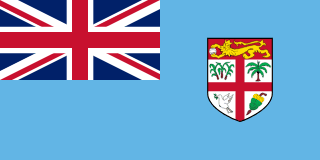
Fiji is an archipelago nation in the South Pacific, sitting northeast of New Zealand and east of Vanuatu, made up of more than 300 islands.
Fiji's name comes from the Fijian word 'Viti,' which early European explorers, particularly Captain Cook, recorded and pronounced in a way that gradually became 'Fiji' in English.
Landscape: Over 300 volcanic and coral islands, mountainous on the larger islands with dense rainforest and coral reefs surrounding them.
Climate: Tropical, warm year-round with a wetter season and cyclone risk.
Food: Kokoda, raw fish marinated in citrus and coconut milk, is widely considered the national dish.
Suva became Fiji's capital in 1877, replacing Levuka, chosen for its superior natural harbour. With a population of around 93,000 in the city itself, it remains the largest city in the South Pacific outside of Australia and New Zealand.
The frigate bird and the tagimoucia flower, found only on the island of Taveuni and blooming in a distinctive red and white pattern, are both closely tied to Fijian identity.
Fijian masi (bark cloth) making, using the inner bark of the paper mulberry tree stamped with traditional patterns, remains a significant ceremonial craft, and traditional Fijian pottery and woodcarving reflect deep Pacific Islander artistic traditions. Traditional Fijian kava ceremonies, involving a ceremonially prepared drink from the kava root, remain a genuinely significant part of social and welcoming customs today.
The Sigatoka Sand Dunes, an unusual coastal dune system, and the historic town of Levuka, Fiji's first colonial capital and a UNESCO World Heritage Site, are among the country's most significant sites. The Garden of the Sleeping Giant, established by actor Raymond Burr, holds one of the largest orchid collections in the South Pacific.
Fiji's coral reefs support extraordinary marine biodiversity, and the islands are home to the Fiji crested iguana, a species discovered by Western science only in 1979 and found nowhere else in the world.
Fiji is religiously mixed, with a Christian majority among ethnic Fijians and a significant Hindu and Muslim population among Fijians of Indian descent, whose ancestors arrived as indentured labourers during British colonial rule. Traditional Fijian village protocol, including formal welcome ceremonies involving kava, remains genuinely observed when visiting many rural communities.
Fiji is a significant exporter of sugar and mineral water, alongside a tourism industry that forms one of the largest parts of the national economy.
Fiji Day on October 10th marks 1970, when Fiji gained sovereignty from British colonial rule. Given Fiji's mixed ethnic Fijian and Indo-Fijian population, the country officially recognises major holidays across Christian, Hindu, and Muslim traditions, including Diwali and Eid alongside Christmas. Fiji's Girmit Day in May commemorates the arrival of the first indentured Indian labourers to the islands.
Rugby sevens holds a place in Fijian national identity matched by few other sports anywhere in the world, the country's 2016 Olympic gold medal in the sport, Fiji's first ever Olympic medal of any kind, treated as one of the most significant moments in national history. Rugby union more broadly is similarly beloved, and football also draws a significant domestic following. Fijian weightlifting has also produced the country's second-ever Olympic medal in recent years.
Fiji is a parliamentary republic, with a President serving as head of state and a Prime Minister holding real executive power, accountable to a single-chamber Parliament. The country has experienced several military coups since independence, often tied to tensions between its ethnic Fijian majority and significant Indo-Fijian minority, though it has returned to elected civilian government each time. Fiji's tourism industry, centred on its extensive coral reefs and beaches, forms a major part of the national economy.
Tomanivi, on the main island of Viti Levu, is Fiji's highest point at 1,324 metres. The lowest point sits at sea level around the country's many islands. Fiji's volcanic and coral island terrain varies considerably across its more than 300 islands.
Tuvalu's flag shares Fiji's use of a light-blue field with the Union Jack in the canton, both former British colonies retaining that colonial-era element, though Tuvalu's fly carries a scattering of stars representing its own islands rather than Fiji's shield-based coat of arms, different enough to avoid real confusion. Fiji remains one of relatively few Pacific nations to retain the Union Jack in its flag's canton.
Adopted in 1970 upon independence from Britain, retaining the Union Jack in recognition of Fiji's colonial history, unlike many other former British colonies that removed it.
Made up of more than 300 islands, only about a third of which are inhabited.
Play today's Flagpie →© Flagpie 2026