
Africa
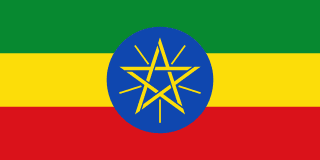
Ethiopia is a landlocked country in the Horn of Africa, bordered by Eritrea to the north, Djibouti and Somalia to the east, Kenya to the south, and South Sudan and Sudan to the west.
Ethiopia's name comes from an ancient Greek word roughly meaning 'burnt faces,' used by Greek writers to describe the peoples living south of Egypt, later adopted as the country's own name.
Landscape: Dominated by a high central plateau split by the Great Rift Valley, with lowland desert regions toward the borders.
Climate: Varies hugely by elevation, temperate in the highlands, hot and arid in the lowlands.
Food: Injera, a spongy sourdough flatbread, is eaten with nearly every meal, typically topped with a range of spiced stews called wat.
Addis Ababa, meaning 'new flower' in Amharic, was founded in 1886 by Emperor Menelik II and his wife Empress Taytu, who chose the site partly for its natural hot springs. With a population of around 3.4 million, it serves as headquarters for the African Union, giving it particular significance as a political centre for the wider continent.
The lion, specifically the Lion of Judah, has deep significance in Ethiopian imperial history and Rastafarian belief, tied to a claimed royal lineage descending from the biblical King Solomon. The Abyssinian rose is closely associated with Ethiopian national identity.
Ethiopian weaving, particularly of the traditional white cotton habesha kemis dress, and intricate cross pendant metalwork tied to the country's ancient Orthodox Christian tradition, remain actively practised crafts today.
The rock-hewn churches of Lalibela, carved directly downward into volcanic rock in the 12th and 13th centuries, are among the most remarkable religious structures in the world, and Aksum, home to ancient obelisks, was the centre of a major ancient civilisation.
The Ethiopian wolf, the rarest canid in the world, survives only in the country's high Bale Mountains, and the Simien Mountains are home to the gelada, a distinctive primate species found nowhere else.
Ethiopia has one of the oldest Christian traditions in the world, with the Ethiopian Orthodox Church dating back to the 4th century, alongside a significant Muslim population, and the country was never formally colonised by a European power, a source of particular national pride.
Ethiopia, widely regarded as the birthplace of coffee, is one of Africa's largest coffee exporters, alongside oilseeds and cut flowers, a rapidly growing export industry in recent years.
Ethiopian New Year (Enkutatash) falls in September according to the distinct Ethiopian calendar, which runs roughly seven to eight years behind the Gregorian calendar used elsewhere, a genuinely unusual feature of Ethiopian timekeeping. Timkat in January, marking Epiphany in the Ethiopian Orthodox tradition, involves elaborate processions and ritual water blessings, and Adwa Victory Day in March commemorates Ethiopia's decisive 1896 defeat of an invading Italian army, a source of enduring national and pan-African pride.
Long-distance running holds a place in Ethiopian national identity comparable to Kenya's, the country having produced a remarkable succession of the world's most dominant marathon and distance runners for decades, a tradition often traced back to Abebe Bikila's barefoot marathon gold at the 1960 Olympics. Football also draws a significant domestic following. Ethiopia's high-altitude training centres have become a genuine destination for elite runners worldwide seeking to replicate the country's natural conditions.
Ethiopia is a federal parliamentary republic, with a largely ceremonial President as head of state and a Prime Minister holding real executive power, accountable to a bicameral parliament. The country's federal structure, organised along ethnic and linguistic lines into regional states, reflects Ethiopia's genuinely significant internal diversity, home to more than 80 distinct ethnic groups.
Ras Dashen, in the Simien Mountains, is Ethiopia's highest point at 4,550 metres, part of a dramatic range that's also home to the endangered gelada monkey and Ethiopian wolf. The Danakil Depression holds the lowest point at around 125 metres below sea level, one of the hottest, most geologically active places on Earth.
Ghana, Senegal, Guinea, and numerous other African nations all use variations of Ethiopia's green-yellow-red colour combination, not by coincidence, Ethiopia's flag directly inspired the broader Pan-African colour tradition after gaining special significance as the only African nation never colonised, making this the single most widely copied colour scheme on the entire continent.
Ethiopia's flag colours are the original source of the Pan-African palette used across the continent, the current emblem was added in 1996.
One of only two African countries never colonised by a European power, and widely regarded as the birthplace of coffee.
Play today's Flagpie →© Flagpie 2026