
Africa
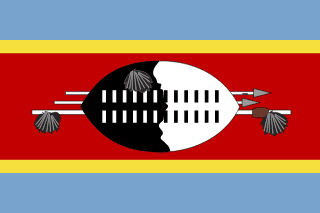
Eswatini is a small, landlocked country in southern Africa, almost entirely surrounded by South Africa except for its border with Mozambique to the east. It was known as Swaziland until 2018.
Eswatini's name means 'land of the Swazis,' the country's dominant ethnic group, and the country was renamed from Swaziland to Eswatini in 2018 by royal decree, partly to avoid confusion with Switzerland.
Landscape: A small, landlocked country ranging from mountainous highveld in the west to lower-lying bushveld in the east.
Climate: Varies by elevation, temperate in the highlands, subtropical and hotter in the lowveld.
Food: Sishwala, a thick maize porridge, is the everyday staple, typically served with a meat or vegetable relish.
Eswatini has two capitals, Mbabane, the administrative capital, and Lobamba, the legislative and royal capital, a division reflecting the country's traditional governance structure alongside its modern parliamentary system. Mbabane, with a population of around 95,000, was founded around a trading post in the late 19th century.
The lion and elephant both appear on Eswatini's coat of arms, tied to the country's monarchy, and traditional Swazi dress, worn genuinely and regularly rather than purely ceremonially, remains a significant part of everyday cultural expression.
Swazi glass-blowing and candle-making have become significant modern craft export industries, and traditional Swazi grass basket weaving and beadwork remain widely practised, often for both ceremonial and everyday use. Traditional Swazi wire art and telephone-wire basketry have become significant modern craft exports, blending old weaving techniques with contemporary materials.
The Ezulwini Valley, home to significant royal and cultural sites, and Mlilwane Wildlife Sanctuary, the country's first protected area, are among Eswatini's most visited landmarks. Sibebe Rock, one of the largest exposed granite domes in the world, offers dramatic hiking and views near Mbabane.
Hlane Royal National Park, Eswatini's largest protected area, is home to lions, elephants, and significant rhinoceros populations, actively managed as part of the country's conservation efforts.
Eswatini is majority Christian, though traditional Swazi customs and the country's absolute monarchy, one of the last remaining in the world, remain deeply significant, including the annual Umhlanga (Reed Dance) ceremony. The Incwala ceremony, a sacred annual kingship ritual, remains one of the most significant events in the Swazi cultural and royal calendar.
Eswatini is a significant exporter of sugar and wood pulp, with its economy closely integrated into and dependent on trade with neighbouring South Africa.
Independence Day on September 6th marks 1968, when Eswatini (then Swaziland) gained sovereignty from British colonial rule. Umhlanga (Reed Dance) in late August or early September is one of the country's most significant traditional ceremonies, involving thousands of young women presenting reeds to the Queen Mother in a centuries-old ritual. Eswatini's Commonwealth Day observances reflect the kingdom's continued ties to the wider Commonwealth of Nations.
Football holds the largest domestic following in Eswatini, and traditional Swazi stick fighting, tied to broader cultural ceremonies, remains practised as both a competitive sport and a rite of passage in some communities. Athletics has also produced modest international recognition for the small kingdom. Eswatini athletics has grown through participation in regional southern African competitions.
Eswatini is an absolute monarchy, one of the last remaining in the world, with the King holding supreme executive authority alongside an appointed and partially elected parliament with limited independent power. The country's monarchy retains deep traditional and ceremonial authority that extends well beyond formal political structures. Eswatini renamed itself from Swaziland in 2018 by royal decree, partly to avoid confusion with Switzerland.
Emlembe is Eswatini's highest point at 1,862 metres. The lowest point is along the Great Usutu River, sitting around 21 metres above sea level, Eswatini's lowest point despite being well above true sea level, since the country is entirely landlocked. Eswatini's terrain descends from highland areas in the west to lower bushveld in the east.
South Africa's flag shares a broadly similar multi-colour palette with Eswatini's own blue-yellow-red-yellow-blue horizontal bands and central shield, though the actual layouts differ enough, South Africa's Y-shape against Eswatini's striped design with a warrior's shield, that the two aren't especially likely to be confused despite both drawing on similar regional colour traditions. Eswatini's warrior shield and spears are a distinctive detail not closely echoed by neighbouring South Africa's own flag design.
Designed by King Sobhuza II.
Adopted in 1968 at independence, based on a military flag first presented to Swazi regiments in 1941.
One of the last remaining absolute monarchies in the world.
Play today's Flagpie →© Flagpie 2026