
Europe
Estonia is the northernmost of the three Baltic states, bordered by Russia to the east and Latvia to the south, with coastlines on the Baltic Sea and the Gulf of Finland.
Estonia's name likely derives from an old Germanic or Scandinavian term referring to the eastern Baltic region, recorded in various forms by ancient writers including the Roman historian Tacitus.
Landscape: Mostly flat, low-lying and heavily forested, with more than 2,000 islands off its Baltic coastline.
Climate: Temperate, with cold winters and mild summers, moderated somewhat by the Baltic Sea.
Food: Black rye bread is a genuine national staple, alongside a strong tradition of smoked and pickled fish.
Tallinn has roots as a trading post dating back centuries, becoming a significant Hanseatic League member city in the medieval period, and grew into capital of modern Estonia. With a population of around 460,000, its Old Town is remarkably well preserved and a UNESCO World Heritage Site.
The barn swallow is Estonia's national bird, and the cornflower, found throughout the country's fields, is the national flower, both chosen through public vote processes.
Estonian folk singing traditions, particularly the Estonian Song Festival held every five years and drawing enormous crowds, are recognised by UNESCO, and traditional Estonian knitting patterns, particularly from the island of Kihnu, remain actively practised. Estonia has also become known more recently for its digital innovation, including being the birthplace of Skype, a somewhat unexpected modern addition to its cultural export profile.
Tallinn's Old Town, with its intact medieval walls and towers, is Estonia's most significant historic site, and the country's extensive network of bogs and wetlands, including Soomaa National Park, offer a landscape unlike much of the rest of Europe. Estonia's Lahemaa National Park, established in 1971, was the first national park created within the entire former Soviet Union.
Estonia has one of the highest densities of brown bears, wolves, and lynx in Europe relative to its population, and its extensive coastline and islands support significant seal and seabird populations.
Estonia is among the most secular countries in the world, with a large majority of the population identifying with no religion, a legacy of both Soviet-era state atheism and a historically weaker religious tradition compared to some neighbours.
Estonia is a significant exporter of machinery, wood products, and electronics, and has built a strong reputation for digital government services and technology start-ups relative to its small population.
Independence Day on February 24th marks 1918, when Estonia first declared independence, and Victory Day on June 23rd commemorates a 1919 battle during the Estonian War of Independence, followed immediately by Jaanipäev (Midsummer) on June 24th, together forming one of the country's most significant celebration periods each summer. Restoration of Independence Day on August 20th marks 1991, when Estonia re-established sovereignty following the collapse of the Soviet Union. Estonia's national Song Festival, held roughly every five years, draws tens of thousands of singers and is recognised by UNESCO as remarkable cultural heritage.
Cross-country skiing and athletics both hold significant places in Estonian sporting culture, and the country has also become notable for its unusually strong performance in competitive wife-carrying, an event that originated in Finland but has been embraced with genuine enthusiasm across the Baltic and Nordic region. Basketball and volleyball both also draw significant domestic followings. Estonian wrestling has a long competitive history, with the sport once being genuinely central to rural community life.
Estonia is a parliamentary republic, with a President elected by parliament serving a largely ceremonial role and a Prime Minister holding real executive power, accountable to the Riigikogu, Estonia's single-chamber parliament. The country has become particularly notable for its advanced digital government services, allowing citizens to vote, file taxes, and access most public services entirely online.
Suur Munamägi, in the country's southeast, is Estonia's highest point at just 318 metres, reflecting the country's generally flat, low-lying Baltic geography. The lowest point sits at sea level along Estonia's extensive, island-studded coastline.
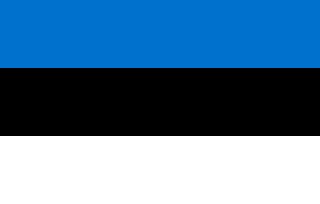
There's no especially close match for Estonia's flag, the blue-black-white horizontal tricolour is a genuinely uncommon colour combination among national flags worldwide, distinctive enough that it isn't easily confused with any other country's design, despite sharing the general three-horizontal-stripe format with dozens of other flags globally.
First adopted in 1918 upon independence, banned during the Soviet era, and formally restored in 1990 as Estonia moved back toward independence.
Has the highest number of recorded meteorite craters per land area of any country on Earth.
Play today's Flagpie →© Flagpie 2026