
Africa
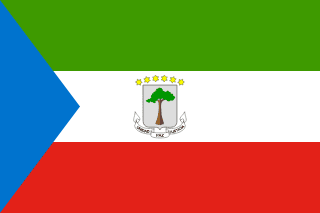
Equatorial Guinea is a small country in Central Africa, made up of a mainland region bordered by Cameroon and Gabon, plus several islands in the Gulf of Guinea. It's the only country in Africa with Spanish as an official language.
Equatorial Guinea's name reflects both its position near the equator and the wider Guinea region of West Africa, adopted upon independence from Spain in 1968 to distinguish it from other nearby countries also using the Guinea name.
Landscape: Split between a mainland region and several islands, including Bioko, mostly covered by dense rainforest.
Climate: Tropical, hot and humid year-round with heavy rainfall.
Food: Succotash, a mix of corn and beans, alongside grilled fish and plantains, reflects the country's coastal and forest food traditions.
Malabo, on the island of Bioko, has served as the country's capital since Spanish colonial times, though the government has been developing Oyala, later renamed Ciudad de la Paz, on the mainland as a planned future capital. With a population of around 300,000 in Malabo, it remains the country's political centre for now, despite the mainland region of Río Muni holding the majority of the country's population.
The silk cotton tree, under which the first treaty between local leaders and Spanish colonists was reportedly signed, appears on Equatorial Guinea's coat of arms alongside six stars representing the mainland and its main islands.
Bubi wood carving and mask-making on Bioko Island, alongside Fang mask traditions on the mainland, reflect deep and distinct spiritual and ceremonial practices specific to the country's different ethnic communities. Traditional Fang storytelling and oral epic poetry, passed down through generations, remain a significant part of mainland cultural heritage.
Monte Alén National Park protects a significant area of Central African rainforest, and Bioko Island's volcanic peaks offer dramatic landscapes distinct from the country's mainland territory.
Bioko Island holds one of the highest concentrations of primate diversity in Africa, including several species of monkey found in very limited ranges, largely due to the island's long isolation from the mainland.
Equatorial Guinea is majority Roman Catholic, reflecting Spanish colonial history, and is the only African country where Spanish is an official language, alongside French and Portuguese.
Equatorial Guinea is a significant oil and natural gas exporter, with hydrocarbons discovered in the 1990s transforming what was once one of Africa's poorest countries into one with a comparatively very high GDP per capita, though wealth distribution has been widely criticised.
Independence Day on October 12th marks 1968, when Equatorial Guinea gained sovereignty from Spain, the only African country to have been a Spanish colony. Armed Forces Day in August honours the country's military, and given the country's Catholic majority, Christmas and Easter are both widely observed. Human Rights Day in December is observed as a formal public holiday, reflecting international pressure on the country's record.
Football holds the largest domestic following in Equatorial Guinea, the national team having co-hosted the Africa Cup of Nations in both 2012 and 2015, a significant point of national pride for a country of its small population. Basketball has also grown in domestic popularity in recent years. Equatoguinean athletics has produced occasional competitors at continental championships.
Equatorial Guinea is a presidential republic, with a President holding substantial executive authority. The country's current President has held office continuously since 1979, one of the longest tenures of any head of state currently in power anywhere in the world, and Equatorial Guinea's significant oil wealth has made it one of Africa's higher GDP-per-capita nations despite widespread poverty among much of the general population. The country's significant oil wealth has funded substantial infrastructure development in its capital and surrounding areas.
Pico Basile, on the island of Bioko, is Equatorial Guinea's highest point at 3,012 metres. The lowest point sits at sea level along the country's coastline, split between its mainland territory and several islands. The country's terrain is split between a mountainous island territory and flatter mainland coastal regions.
There's no especially close match for Equatorial Guinea's flag, the green-white-red horizontal stripes with a blue triangle at the hoist and a detailed coat of arms featuring a silk cotton tree make it a distinctive combination, that specific tree symbol unique to Equatorial Guinea's own founding history. Equatorial Guinea's blue triangle is an uncommon addition compared to other Central African nations' simpler striped designs.
Adopted in 1968 upon independence from Spain, briefly modified during a period of dictatorship in the 1970s before being restored to its original design in 1979.
The only African country where Spanish is an official language.
Play today's Flagpie →© Flagpie 2026