
South America
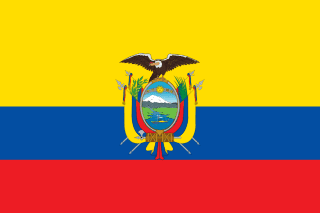
Ecuador is a small country on the Pacific coast of South America, bordered by Colombia to the north and Peru to the south and east. Its name is simply the Spanish word for 'equator,' which runs directly through the country.
Ecuador's name is simply the Spanish word for 'equator,' since the line runs directly through the country, a rare example of a nation named after a purely geographic and astronomical reference point rather than a people, place, or historical figure.
Landscape: Spans the Andes mountains, Amazon rainforest, a Pacific coastline, and the Galápagos Islands roughly 1,000 km offshore.
Climate: Varies enormously by region and altitude, tropical along the coast and in the Amazon, cooler in the Andean highlands.
Food: Ceviche and locro de papa, a hearty potato soup, are widely eaten, alongside a strong tradition of grilled meats.
Quito was founded by the Spanish in 1534 atop the ruins of an earlier Inca city, and sits at over 2,800 metres elevation in the Andes, making it one of the highest capital cities in the world. With a population of around 1.8 million, its well-preserved colonial centre was among the first sites ever designated a UNESCO World Heritage Site, in 1978.
The Andean condor appears on Ecuador's coat of arms, and the country is closely associated internationally with the Galápagos Islands, a Pacific archipelago belonging to Ecuador and famous for inspiring Charles Darwin's theory of evolution.
The Panama hat, despite its name, actually originates in Ecuador, traditionally handwoven from toquilla palm fibre, and Ecuadorian Indigenous communities maintain distinct textile weaving traditions, particularly in the Otavalo region. Ecuadorian wood carving and religious art, particularly from the city of Quito during its colonial period, produced a distinctive artistic school still studied and preserved today.
The Galápagos Islands, roughly 1,000 kilometres off Ecuador's coast, are the country's most internationally significant natural landmark, and the historic centre of Quito remains one of the best-preserved colonial cities in Latin America.
The Galápagos Islands host giant tortoises, marine iguanas, and numerous species found nowhere else on Earth, their isolation having produced some of the most studied examples of evolutionary adaptation in the world. Mainland Ecuador's cloud forests and Amazon basin also host an extraordinary diversity of bird species, including numerous hummingbirds found in very limited ranges.
Ecuador is majority Roman Catholic, and the country is home to significant Indigenous populations, including Quechua-speaking communities descended from the Inca Empire, alongside Afro-Ecuadorian communities concentrated particularly along the coast.
Ecuador is one of the world's largest exporters of bananas, alongside crude oil and shrimp, with agriculture forming an especially significant share of the country's export economy.
Independence Day on August 10th marks 1809, when Quito became one of the first cities in Spanish America to declare independence, even though full sovereignty came later after years of continued conflict. Independence of Guayaquil on October 9th celebrates that city's own 1820 declaration, treated as a major regional holiday given Guayaquil's status as Ecuador's largest city, and Día de los Difuntos on November 2nd, honouring the dead, is marked by visiting cemeteries and sharing a traditional purple corn drink called colada morada. Inti Raymi, an Indigenous Andean sun festival, is celebrated with particular intensity in Otavalo, reflecting the region's strong Indigenous Kichwa community.
Football holds the largest following in Ecuador by a wide margin, and the country has also produced notable success in road cycling given its mountainous Andean terrain, which naturally produces strong climbing specialists. Ecuadorian athletes have found particular success in race walking at the international level too.
Ecuador is a presidential republic, with a President serving as both head of state and government, elected for a single four-year term. The country experienced significant political instability through the 1990s and 2000s, cycling through numerous presidents, though it has seen greater stability in more recent years.
Chimborazo, a dormant volcano, is Ecuador's highest point at 6,263 metres, and due to the equatorial bulge and Chimborazo's position almost directly on the equator, its summit is actually the point on Earth's surface farthest from the planet's centre, further even than Everest by that specific measure. The lowest point sits at sea level along Ecuador's Pacific coastline.
Colombia and Venezuela both use the exact same yellow-blue-red horizontal tricolour Ecuador does, all three tracing back to a shared origin in Gran Colombia, and are typically distinguished only by additional details, Ecuador's detailed central coat of arms in particular setting it apart once visible, though without it the three flags are genuinely easy to mix up.
Based on the flag of Gran Colombia, adopted in its current form in 1900, with the coat of arms formalised soon after.
Home to the Galápagos Islands, one of the most biodiverse places on the planet, and one of the most volcanically active countries in South America.
Play today's Flagpie →© Flagpie 2026