
Africa
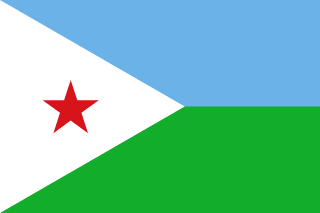
Djibouti is a small country in the Horn of Africa, bordered by Eritrea to the north, Ethiopia to the west and south, and Somalia to the southeast, sitting on the Bab-el-Mandeb strait connecting the Red Sea to the Gulf of Aden.
Djibouti's name likely comes from an Afar word referring to a plate or tray, possibly describing the flat geological features of the region, though the precise original meaning remains debated.
Landscape: Mostly arid desert and volcanic terrain along the Horn of Africa, with the Bab-el-Mandeb strait offering strategic access to the Red Sea.
Climate: Extremely hot and arid, among the hottest countries in the world.
Food: Skoudehkaris, spiced rice with meat, is a widely eaten dish, reflecting Djibouti's mix of Somali, Afar, and Arab culinary influence.
Djibouti City has served as the country's capital since French colonial administration established it as a port in the late 19th century, chosen specifically for its strategic position on the Bab-el-Mandeb strait connecting the Red Sea to the Gulf of Aden. With a population of around 600,000, well over half the country's total population, it remains overwhelmingly dominant both politically and economically.
The Djibouti francolin, a rare bird found only in a small forested region of the country, is a significant national conservation symbol, reflecting the country's otherwise largely arid landscape.
Djiboutian craft traditions reflect both Afar and Somali cultural heritage, including traditional basket weaving and leatherwork historically tied to the region's nomadic pastoral lifestyle. Traditional Djiboutian silverwork and woven mat-making remain practised by both Afar and Somali communities, each with distinct regional patterns.
Lake Assal, one of the lowest points in Africa and one of the saltiest bodies of water in the world, is Djibouti's most striking natural landmark, and the country's position along a major shipping route has made it host to several significant international military bases.
The Day Forest National Park protects one of the last remaining forest habitats in this largely desert country, home to the critically endangered Djibouti francolin. Djibouti's waters in the Gulf of Tadjoura are considered one of the best places in the world to swim with whale sharks during their seasonal aggregation.
Djibouti is overwhelmingly Muslim, and the country's population is split between Afar and Somali ethnic communities, both with deep nomadic pastoral traditions still practised by significant portions of the rural population.
Djibouti's economy is built substantially around its strategic port and shipping services rather than significant goods exports, serving as a critical maritime gateway for landlocked Ethiopia's trade.
Independence Day on June 27th marks 1977, when Djibouti gained sovereignty from France, the last French colonial territory in mainland Africa to do so. Given Djibouti's significant Muslim population, Eid al-Fitr and Eid al-Adha are both major national holidays, alongside a smaller Christian minority observing Christmas. Djibouti's Labour Day in May is marked with public gatherings reflecting the country's port-based working economy.
Football holds the largest domestic following in Djibouti, and long-distance running has produced the country's most significant individual international recognition, following a similar regional pattern to nearby Ethiopia and Kenya, given Djibouti's comparable highland terrain and climate. Djiboutian athletics has grown through the same regional East African distance-running tradition shared with its neighbours.
Djibouti is a presidential republic, with a President serving as both head of state and government. The country's strategic position along the Bab-el-Mandeb strait, connecting the Red Sea to the Gulf of Aden, has made it host to a notable concentration of foreign military bases from multiple countries, a significant source of national revenue. Djibouti's economy relies significantly on port and logistics services given its strategic maritime location. Djibouti's port serves as the primary maritime gateway for landlocked Ethiopia's international trade.
Moussa Ali is Djibouti's highest point at 2,028 metres. Lake Assal holds the lowest point at around 155 metres below sea level, the lowest point in Africa and one of the lowest points on Earth's land surface outside the Dead Sea region. Djibouti's terrain includes some of the most extreme heat and lowest points found anywhere on the African continent.
Somalia's flag shares a similar light-blue field with Djibouti's own light-blue-and-green design, both reflecting the wider Somali cultural region, though Djibouti's added green triangle and white star set it apart from Somalia's simpler single-star design. Djibouti's light blue and green combination sets it apart from most other Horn of Africa nations' flag colours.
Adopted in 1977 at independence from France, based on the flag used by the country's main independence movement.
Home to Lake Assal, one of the lowest points in Africa and one of the saltiest bodies of water on Earth.
Play today's Flagpie →© Flagpie 2026