
Europe
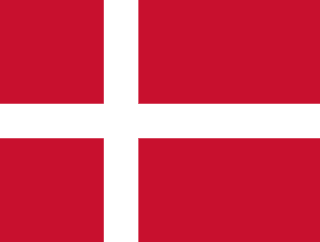
Denmark sits in Northern Europe, made up of the Jutland peninsula bordering Germany to the south, plus a large number of islands between the North Sea and the Baltic Sea.
This flag has the highest proportion of crimson of any flag in Flagpie, at 77%.
Denmark's name likely combines an old word for a border region or forest with 'mark,' meaning borderland, referring to its position as the southern frontier of the historic Danish kingdom against Germanic lands further south.
Landscape: Low, flat farmland making up most of the country, spread across the Jutland peninsula and over 400 islands.
Climate: Temperate maritime, mild for its latitude, with cool summers and mild, wet winters.
Food: Smørrebrød, an open-faced rye bread sandwich, is a genuine everyday staple, alongside a strong Danish pastry tradition.
Copenhagen grew from a Viking-era fishing village into Denmark's capital by the 15th century, its name deriving from the Danish for 'merchants' harbour,' reflecting its early importance as a trading port. With a population of around 660,000 in the city itself, it remains Denmark's dominant political, economic, and cultural centre.
The mute swan is Denmark's national bird, closely associated with Hans Christian Andersen's fairy tale 'The Ugly Duckling.' The marguerite daisy is widely regarded as Denmark's national flower, closely tied to the country's former Queen Margrethe II.
Danish design has an outsized international reputation in furniture and homeware, built on a 20th-century movement emphasising simplicity and function, and Danish porcelain, particularly from the Royal Copenhagen manufactory founded in 1775, remains a respected craft export.
The Little Mermaid statue in Copenhagen, inspired by Hans Christian Andersen's story, is Denmark's most photographed landmark, and Kronborg Castle, the setting for Shakespeare's Hamlet, is a UNESCO World Heritage Site. Denmark's Jelling Stones, massive carved runestones from the 10th century, are sometimes called the 'birth certificate' of the Danish nation, marking the country's conversion to Christianity.
Denmark's largely flat, farmed landscape supports fewer large wild mammals than its Nordic neighbours, though red deer and roe deer are both native, and the country's coastal waters and wetlands support significant seabird populations.
The Evangelical Lutheran Church of Denmark remains the country's official state church, though actual religious practice is low, with most Danes engaging with the church mainly for major life events like baptisms and funerals rather than regular worship.
Denmark is a significant exporter of pharmaceuticals, particularly through companies like Novo Nordisk, alongside machinery and agricultural products, especially pork and dairy. Danish wind turbine manufacturing, led by companies like Vestas, has also made the country a significant global exporter of renewable energy technology.
Constitution Day on June 5th marks the 1849 adoption of Denmark's first democratic constitution, a relatively low-key holiday compared to many countries' national days, in keeping with Danish cultural preference for understatement. Midsummer, marked with bonfires on beaches nationwide on Sankt Hans Aften (Saint John's Eve), and Christmas, with its distinctly Danish emphasis on hygge and candlelit cosiness, are both significant seasonal celebrations. Store Bededag (Great Prayer Day), historically a significant religious holiday, was controversially removed from the official calendar in 2023 to boost national labour output.
Football and handball both hold major followings in Denmark, the men's handball team having become one of the most successful international programmes in the sport in recent years, and Denmark's men's football team pulled off one of the most celebrated underdog wins in tournament history at Euro 1992, entering only as a late replacement.
Denmark is a parliamentary constitutional monarchy, with the monarch serving a ceremonial role and real executive power held by a Prime Minister accountable to the Folketing, Denmark's single-chamber parliament. The Kingdom of Denmark also includes Greenland and the Faroe Islands, both of which hold significant self-governing autonomy while remaining formally part of the wider kingdom.
Møllehøj, at just 170.86 metres, is Denmark's highest point on the mainland, reflecting the country's famously flat, low-lying geography, among the lowest 'highest points' of any country in the world. The lowest point is a reclaimed polder area near Lammefjord, sitting around 7 metres below sea level.
Norway's flag is Denmark's closest cousin, both built on the same Nordic cross, Norway's essentially Denmark's own cross with an added blue stripe layered on top, since Norway's flag was deliberately designed drawing on Denmark's during their long historical union. Sweden, Finland, and Iceland all also carry the same underlying cross Denmark's flag originated, the oldest continuously used national flag design in the world.
The Dannebrog is the oldest continuously used national flag design in the world, in use in some form since at least the 14th century, formalised by royal decree over the following centuries.
Home to the oldest national flag design still in continuous use anywhere in the world.
Play today's Flagpie →© Flagpie 2026