
Africa
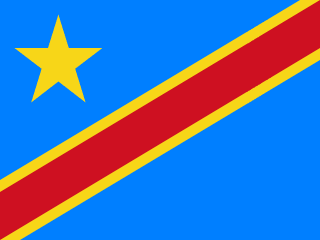
The Democratic Republic of the Congo sits in Central Africa, bordered by nine other countries including the Republic of the Congo, the Central African Republic, South Sudan, and Zambia, with a small stretch of Atlantic coastline in the west.
The Democratic Republic of the Congo takes its name from the Congo River, itself named after the Kongo Kingdom, a powerful pre-colonial state that once controlled significant territory along the river's lower reaches.
Landscape: Dominated by the Congo River basin and the second-largest rainforest in the world, with highlands along the eastern border.
Climate: Tropical, hot and humid along the equator, with distinct wet and dry seasons further from it.
Food: Fufu, a starchy dough usually made from cassava, is the everyday staple, typically served with a leafy green stew called saka saka.
Kinshasa was founded in 1881 by explorer Henry Morton Stanley as a trading post and grew into one of the largest cities in Africa, with a population of around 17 million making it the largest French-speaking city in the world by population, larger even than Paris.
The leopard has historically been closely tied to Congolese political and cultural symbolism, particularly during the Mobutu era, and the Congo River itself functions as a powerful unofficial national symbol given its central role in the country's geography and history.
Congolese wood carving and mask-making, particularly among the Kuba and Luba peoples, are considered among the most significant and influential traditions in African art history, and Congolese rumba music has had major influence across the wider African continent. Congolese fashion culture, particularly the sapeur movement centred on elaborate, colourful tailored suits, has become an internationally recognised expression of Congolese identity and style.
Virunga National Park, Africa's oldest national park and home to critically endangered mountain gorillas, is one of the country's most significant natural landmarks, alongside the Congo River itself, the second-longest river in Africa.
The DRC holds a significant share of the Congo Basin rainforest, the second-largest rainforest in the world, home to forest elephants, bonobos found nowhere else on Earth, and mountain gorillas.
The DRC is majority Christian, with both Catholic and Protestant traditions well represented, and the country is home to over 200 ethnic groups and hundreds of languages, reflecting its vast size and complex history.
The DRC holds some of the largest cobalt reserves in the world, a mineral increasingly critical for battery production, alongside copper and diamonds, with mining forming a dominant share of the national economy.
Independence Day on June 30th marks 1960, when the DRC gained sovereignty from Belgian colonial rule, a transition marked by significant early post-independence turmoil that shaped much of the country's subsequent history. Given the DRC's vast size and diversity, regional and religious holidays vary significantly across different provinces. Parents' Day in August honours family elders with nationwide gatherings and gift-giving traditions.
Football holds the largest domestic following in the DRC by a wide margin, and the country's traditional dance and rumba music, deeply influential across the wider African continent, carries a cultural weight that rivals major sporting events in national identity, even though it isn't itself a sport. Congolese basketball has also produced players who've gone on to notable professional careers abroad.
The DRC is a semi-presidential republic, splitting executive authority between a directly elected President and a Prime Minister accountable to a bicameral parliament. The country has experienced significant instability since independence, including the assassination of its first Prime Minister within months of sovereignty and decades of subsequent conflict, particularly in its mineral-rich eastern regions. The DRC holds some of the largest cobalt reserves in the world, an increasingly strategically significant resource.
Mount Stanley (Margherita Peak), shared with Uganda, is the DRC's highest point at 5,109 metres, part of the Rwenzori range and unusually glaciated for a peak so close to the equator. The lowest point sits at sea level along the DRC's very short Atlantic coastline. The DRC's vast size means its terrain ranges from dense lowland rainforest to significant mountain ranges along its eastern border.
The Republic of the Congo, its smaller neighbour sharing a name and the Congo River, uses different colours entirely from the DRC's own blue-yellow-red diagonal design with a central star, meaning despite their similar names, the two countries' actual flags aren't especially likely to be visually confused.
The current design was readopted in 2006, based closely on the country's original 1963 flag, after several different versions were used during periods of political upheaval, including one under the name Zaire.
One of only 17 officially recognised 'megadiverse' countries, home to a huge share of the Congo Basin rainforest.
Play today's Flagpie →© Flagpie 2026