
Europe
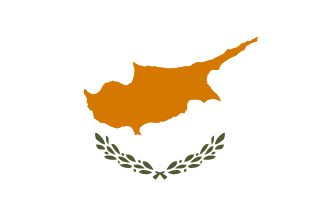
Cyprus is an island nation in the eastern Mediterranean Sea, south of Turkey and west of Syria and Lebanon.
This flag has the highest proportion of white of any flag in Flagpie, at 90%.
Cyprus's name is closely tied to copper, with the Latin word for copper, 'cuprum,' actually derived from the island's name rather than the other way around, reflecting Cyprus's ancient importance as a copper-producing centre.
Landscape: Two mountain ranges (the Troodos and Kyrenia) separated by a fertile central plain, with coastline surrounding the whole island.
Climate: Mediterranean, hot dry summers and mild wet winters.
Food: Halloumi cheese, which originated on the island, is Cyprus's best known food export, alongside souvlaki and a strong Mediterranean mezze tradition.
Nicosia has been continuously inhabited for thousands of years and remains the world's last divided capital city, split between the internationally recognised Republic of Cyprus in the south and the Turkish Republic of Northern Cyprus, recognised only by Turkey, in the north. With a population of around 350,000 across the wider city, the divide dates back to a 1974 conflict that remains formally unresolved.
The Cyprus mouflon, a wild sheep found only on the island, is Cyprus's national animal, and the country's flag itself, showing a map of the island in copper-orange, is one of the more unusual national symbols in the world.
Cypriot lace-making, particularly from the village of Lefkara, is recognised by UNESCO, and traditional pottery-making on the island has roots stretching back thousands of years to some of the earliest Mediterranean civilisations.
The archaeological site of Paphos, with mosaics dating back to Roman times, is a UNESCO World Heritage Site, and the Troodos Mountains are home to a cluster of painted Byzantine churches also recognised by UNESCO.
The Cyprus mouflon, once nearly extinct, survives in protected areas within the Troodos Mountains, and the island's position along Mediterranean migration routes makes it an important stopover for numerous bird species. The island's Akamas Peninsula remains one of the least developed coastal areas in the Mediterranean and an important nesting site for endangered green and loggerhead sea turtles.
Cyprus is majority Greek Orthodox Christian in the south and majority Muslim in the north, a religious divide that closely mirrors the island's political division between Greek and Turkish Cypriot communities.
Cyprus is a significant exporter of pharmaceuticals and citrus fruits, and its shipping registry is one of the largest in the world, with a significant share of global merchant vessels registered there.
Cyprus Independence Day on October 1st marks 1960, when the island gained sovereignty from British colonial rule, though the island's subsequent division means the date is marked differently, or not at all, in the Turkish-administered north. Greek Cypriots additionally observe Greek national holidays given their cultural ties to Greece, while Turkish Cypriots in the north observe Turkish national holidays, reflecting the island's ongoing political split. Kataklysmos, the Festival of the Flood, held after Pentecost, involves water-themed festivities along the coast with roots predating Christianity.
Football holds the largest domestic following in Cyprus, and the country has also produced notable success in sailing and tennis relative to its small population. Cyprus's mountainous interior also supports a modest but genuine skiing tradition, unusual for a Mediterranean island nation. Cyprus has also produced competitive shooters and rowers at the international level relative to its very small population.
Cyprus is formally a presidential republic in its internationally recognised south, with a President serving as both head of state and government, while the self-declared Turkish Republic of Northern Cyprus in the north, recognised only by Turkey, operates its own separate parliamentary system. This division, dating to a 1974 conflict, remains formally unresolved despite decades of periodic reunification talks. Reunification talks between the island's two communities have continued intermittently for decades without a lasting resolution.
Mount Olympus (Chionistra), in the Troodos Mountains, is Cyprus's highest point at 1,952 metres, and is home to the island's only ski resort. The lowest point sits at sea level around the island's coastline.
There's no other national flag quite like Cyprus's, the copper-orange silhouette map of the island itself set on a plain white field is one of only two national flags in the world to depict an outline of the country's own shape, making it genuinely unmistakable despite its otherwise minimal design.
Adopted in 1960 upon independence, deliberately designed to be neutral, avoiding both Greek and Turkish national colours given the island's mixed population.
One of only two national flags in the world to show an actual outline map of the country itself.
Play today's Flagpie →© Flagpie 2026