
North America
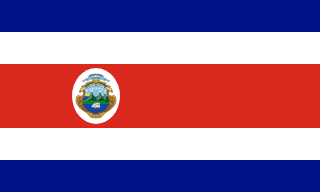
Costa Rica sits in Central America, bordered by Nicaragua to the north and Panama to the south, with coastlines on both the Caribbean Sea and the Pacific Ocean. Its name means 'rich coast' in Spanish.
Costa Rica's name means 'rich coast' in Spanish, given by early Spanish explorers who hoped, largely incorrectly as it turned out, that the region held significant gold deposits.
Landscape: Mountainous and volcanic through the centre, with tropical lowlands and coastline on both the Pacific and Caribbean.
Climate: Tropical, with a wet and dry season, temperatures moderated in the highland areas.
Food: Gallo pinto, rice and beans typically eaten for breakfast, is considered the national dish.
San José became Costa Rica's capital in 1823, chosen over rival cities partly due to its coffee-growing region's growing economic importance at the time. With a population of around 340,000 in the city itself, it sits in the country's Central Valley at a comfortable elevation that moderates the tropical climate.
The clay-coloured thrush, a relatively plain-looking bird whose song is closely associated with the start of the rainy season, is Costa Rica's national bird, and the guaria morada, a purple orchid, is the national flower.
The oxcart, painted in vivid geometric patterns, is one of Costa Rica's most recognised craft traditions, historically used to transport coffee and recognised by UNESCO as part of the country's cultural heritage. Costa Rican coffee cultivation is treated with particular national pride, with many small family farms still processing beans using traditional methods passed down through generations.
Arenal Volcano, one of Costa Rica's most active volcanoes, and Monteverde Cloud Forest, home to extraordinary biodiversity within a relatively small protected area, are both among the country's most visited natural landmarks.
Costa Rica holds an extraordinary concentration of biodiversity for its size, including resplendent quetzals, sloths, and over 500,000 species, estimated to represent around 4% of the world's total biodiversity within a country smaller than West Virginia.
Costa Rica is majority Roman Catholic, and the country has been notable for decades for having abolished its military entirely in 1948, redirecting resources toward education and healthcare instead. The national motto 'Pura Vida,' meaning 'pure life,' extends well beyond tourism marketing into a genuine, widely used everyday expression reflecting the country's characteristically relaxed cultural outlook.
Costa Rica is a significant exporter of bananas and coffee, alongside medical devices, an increasingly significant and higher-value export sector in recent years.
Independence Day on September 15th, shared with the rest of Central America, marks 1821, when the region declared independence from Spain, celebrated nationwide with lantern parades held by schoolchildren the evening before. Abolition of the Army Day on December 1st marks 1948, when Costa Rica formally disbanded its military, a decision the country takes particular pride in as part of its national identity. Día de los Boyeros in March celebrates Costa Rica's traditional oxcart culture with a colourful parade of painted carts.
Football holds the largest domestic following in Costa Rica by a wide margin, the national team's run to the 2014 World Cup quarter-finals remaining the most celebrated achievement in the country's sporting history. Surfing has also grown significantly in profile given Costa Rica's globally renowned Pacific and Caribbean coastlines. Costa Rican athletes have also found success in canoeing and kayaking given the country's extensive river systems.
Costa Rica is a presidential republic, with a President serving as both head of state and government, elected for a single four-year term. The country is widely regarded as one of Latin America's most stable democracies, having abolished its military entirely in 1948 and redirected resources toward education, healthcare, and environmental conservation instead.
Cerro Chirripó is Costa Rica's highest point at 3,819 metres, and on exceptionally clear days, both the Pacific Ocean and Caribbean Sea are visible simultaneously from its summit, a rare vantage point. The lowest point sits at sea level along Costa Rica's coastlines on both oceans.
Thailand's flag uses a similar red-white-blue horizontal striped structure to Costa Rica's, though with different stripe proportions and without Costa Rica's coat of arms. North Korea also uses a broadly similar red-white-blue striped layout, different enough in exact arrangement and added symbolism that neither is especially likely to be confused with Costa Rica specifically.
The blue-white-red design dates to 1848, inspired by the French tricolour, with a central red stripe added specifically to distinguish it from other Central American flags of the era.
Packs more species per square kilometre than almost anywhere else on Earth, despite its small size.
Play today's Flagpie →© Flagpie 2026