
Africa
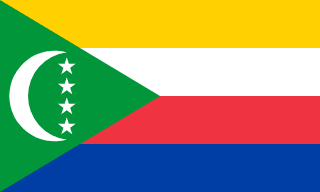
Comoros is a small archipelago nation in the Indian Ocean, sitting in the Mozambique Channel between Madagascar and the East African coast.
Comoros's name comes from the Arabic 'qamar,' meaning moon, though the exact reasoning behind this name for the islands is debated, possibly tied to early Arab traders' impressions of the archipelago.
Landscape: A small volcanic archipelago in the Mozambique Channel, mountainous with limited flat land.
Climate: Tropical, warm and humid year-round with a wetter and drier season.
Food: Langouste à la vanille, lobster cooked with vanilla, reflects Comoros's status as a major vanilla producer.
Moroni, on the island of Grande Comore, has served as Comoros's capital since independence in 1975, its name derived from an Arabic phrase meaning 'at the heart of the fire,' referring to the nearby active volcano, Mount Karthala. With a population of around 60,000, it remains a relatively small but significant regional port city.
The Livingstone's fruit bat, one of the largest bat species in the world and found only in Comoros, is a significant national conservation symbol, and ylang-ylang, a fragrant flower central to the perfume industry, is deeply tied to the country's economy and identity.
Comorian embroidery and traditional wedding ceremony craftwork, including elaborately decorated clothing and jewellery, remain significant living cultural traditions, particularly for the country's Grand Mariage ceremonies. Traditional Comorian boat-building, producing wooden sailing vessels called galawa, remains practised by coastal fishing communities.
Mount Karthala, one of the largest active volcanoes in the world, dominates the island of Grande Comore, and the old town of Moroni, with its historic mosque and Arab-influenced architecture, reflects the islands' long history as an Indian Ocean trading hub.
Comoros is home to the Livingstone's fruit bat and Mongoose lemur, both found in very limited ranges, reflecting the islands' isolation and status as a distinct biodiversity hotspot in the Indian Ocean.
Comoros is overwhelmingly Sunni Muslim, and Islam is deeply integrated into the country's social customs, including its elaborate and economically significant Grand Mariage wedding tradition. The Grand Mariage remains one of the most significant and elaborate social institutions in Comorian society, often taking years of saving to properly hold.
Comoros is the world's largest producer and exporter of ylang-ylang, a key ingredient in perfumes including Chanel No. 5, alongside vanilla and cloves.
Independence Day on July 6th marks 1975, when Comoros gained sovereignty from France, though the nearby island of Mayotte voted to remain French, a still-contested point in Comorian politics today. Given Comoros's overwhelmingly Muslim population, Eid al-Fitr and Eid al-Adha are both major national holidays. Comoros's Wedding Season traditions, particularly the elaborate Grand Mariage, remain genuinely significant social institutions.
Football holds the largest domestic following in Comoros, the national team's surprise qualification for the 2021 Africa Cup of Nations, its first ever major tournament appearance, treated as a landmark achievement for one of Africa's smallest and least internationally prominent footballing nations. Comorian athletics participation has grown through regional Indian Ocean Island Games competition.
Comoros is a federal presidential republic, with a President serving as both head of state and government, and a rotating presidency historically shared among the country's three main islands. The country has experienced significant political instability since independence, including numerous coups and attempted coups, among the highest counts of any nation in the world relative to its short history. Comoros's economy relies heavily on agriculture, particularly vanilla and ylang-ylang production for the global perfume industry. Comoros's economy remains among the smallest in Africa, heavily dependent on remittances and agriculture. Comoros holds close ties with France despite its independence, given the continued French administration of nearby Mayotte.
Mount Karthala, an active volcano on Grande Comore, is Comoros's highest point at 2,361 metres. The lowest point sits at sea level around the archipelago's islands. Comoros's volcanic origins give it dramatic terrain despite the archipelago's small total land area.
There's no especially close match for Comoros's flag, the four horizontal stripes representing the country's main islands, combined with a green triangle bearing a crescent and four stars, make it a distinctive and visually detailed combination not closely replicated elsewhere. Comoros's four-stripe design is distinctive enough to stand apart from other Indian Ocean island nations' flags.
Adopted in 2001, combining the four crescents and stars of the country's four main islands into one design.
Known as the 'Perfume Islands,' producing much of the world's ylang-ylang, a key ingredient in Chanel No. 5 and other famous perfumes.
Play today's Flagpie →© Flagpie 2026