
South America
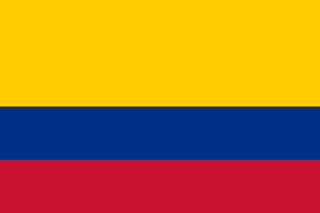
Colombia sits in the northwest corner of South America, the only country on the continent with coastlines on both the Caribbean Sea and the Pacific Ocean, bordered by Panama, Venezuela, Brazil, Peru, and Ecuador. It's named after Christopher Columbus.
Colombia is named after Christopher Columbus, chosen by Venezuelan revolutionary Francisco de Miranda in the late 18th century as a name for the whole of Spanish-ruled South America, later narrowed to apply specifically to the country that eventually formed.
Landscape: Includes Andes mountain ranges, Amazon rainforest, Caribbean and Pacific coastline, and the Llanos, wide tropical grassland plains.
Climate: Tropical, though heavily shaped by altitude, coastal lowlands are hot while cities in the Andes stay mild year-round.
Food: Bandeja paisa, a large mixed platter of beans, rice, meat and plantain, is considered a national dish, alongside arepas, a corn cake eaten with nearly every meal.
Bogotá was founded in 1538 by Spanish conquistador Gonzalo Jiménez de Quesada, following a difficult expedition into the Andes and conquest of the Muisca people who lived there previously. Sitting on a high plateau at over 2,600 metres elevation, with a population of around 8 million, it became Colombia's political centre partly because of that defensible, cool mountain position.
The Andean condor, one of the largest flying birds in the world, is Colombia's national animal, revered by Indigenous Andean cultures long before Spanish arrival as a sacred messenger between the living and the divine. The orchid Cattleya trianae is the national flower, named after Colombian naturalist José Jerónimo Triana.
The sombrero vueltiao, a distinctive woven hat originating with the Zenú Indigenous people, has become a genuine national symbol of Colombia, alongside mochila bags, hand-woven by several Indigenous groups and now a widely recognised Colombian export.
The Salt Cathedral of Zipaquirá, an entire underground church carved from a salt mine, is one of Colombia's more unusual landmarks, alongside the walled colonial city of Cartagena, a UNESCO World Heritage Site.
The wax palm, the tallest palm tree species in the world, grows almost exclusively in Colombia's Cocora Valley, and the country's position spanning Andean, Amazonian, and Caribbean ecosystems makes it one of the most biodiverse nations on Earth for its size.
Colombia is majority Roman Catholic, reflecting Spanish colonial history, and is ethnically diverse, with Indigenous, European, and African heritage all shaping regional culture differently across the country.
Colombia is one of the world's largest exporters of coffee, alongside crude oil, coal, and cut flowers, with Colombian coffee in particular carrying a strong international reputation for quality.
Independence Day on July 20th marks 1810, when the movement toward independence from Spain began, though full sovereignty came later after years of conflict. Carnival of Barranquilla, held in the days before Lent, is one of the largest carnival celebrations in the world and a UNESCO-recognised cultural tradition, and Semana Santa (Holy Week) is marked by elaborate religious processions, particularly in the city of Popayán.
Football holds the largest following in Colombia, the national team's golden generation of the early 1990s having significantly raised the country's international profile in the sport. Tejo, a traditional game involving throwing a metal disc at a target packed with small gunpowder charges designed to explode on impact, was officially declared Colombia's national sport in 2000, a genuinely unusual and distinctly local pastime.
Colombia is a presidential republic, with a President serving as both head of state and government, elected for a single four-year term. The country experienced a decades-long internal armed conflict involving guerrilla groups, paramilitaries, and drug cartels, significantly de-escalated by a landmark 2016 peace agreement with the FARC, one of the conflict's largest armed groups.
Pico Cristóbal Colón, in the isolated Sierra Nevada de Santa Marta range, is Colombia's highest point at 5,730 metres, unusual for sitting so close to the Caribbean coast rather than within the Andes proper. The lowest point sits at sea level along Colombia's coastlines on both the Caribbean and Pacific.
Venezuela and Ecuador both use the exact same yellow-blue-red horizontal tricolour Colombia does, all three tracing back to a shared origin in Gran Colombia, the short-lived republic that once encompassed all three countries plus Panama. They're typically distinguished only by additional details, Venezuela's arc of stars, Ecuador's central coat of arms, while Colombia's plain three-band design without any added emblem is the simplest of the three, making it the version most easily mistaken for either of the others.
Based on the flag of Gran Colombia, a short-lived republic that included modern-day Colombia, Venezuela, Ecuador and Panama, adopted in its current proportions in 1861.
Home to more bird species than any other country on Earth, around 1,900 in total.
Play today's Flagpie →© Flagpie 2026