
Asia
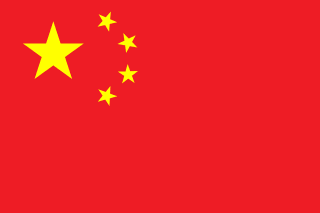
China sits in East Asia, the third-largest country in the world by area, bordering more countries than almost any other nation, with coastlines on the Yellow, East China, and South China Seas.
This flag has the highest proportion of red of any flag in Flagpie, at 98%.
The English name 'China' most likely derives from 'Qin' (pronounced roughly 'chin'), the dynasty that first unified the country in 221 BC, transmitted to Europe through Persian and Sanskrit intermediaries along trade routes. China's own name for itself, Zhongguo, translates to 'Middle Kingdom,' reflecting a historical view of China as the cultural centre of the world.
Landscape: Enormously varied, from the Himalayas and Tibetan Plateau in the west to fertile river basins and a long eastern coastline.
Climate: Ranges from subarctic in the far north to tropical in the south, with much of the country experiencing four distinct seasons.
Food: Regional cuisine varies enormously, from Sichuan's heavy use of chilli and Sichuan pepper to Cantonese cooking's lighter, seafood-driven style.
Beijing has served as China's capital for most of the last 800 years, first under the Yuan dynasty and continuously since, aside from a few shorter interruptions, with the notable exception of the early Ming period when Nanjing briefly held the role. Home to over 21 million people, its name simply means 'northern capital,' distinguishing it from Nanjing, whose name means 'southern capital.'
The giant panda, found only in a handful of mountainous Chinese provinces, is the country's most recognised unofficial national symbol and a central part of its conservation efforts and diplomacy. The dragon holds deep cultural significance across Chinese history, traditionally associated with imperial power, though it isn't an officially designated national symbol.
The qipao (or cheongsam) and hanfu are among China's best-known traditional garments, the former a fitted dress popularised in the 20th century, the latter referring to a much older style of dress predating it by centuries. Chinese silk weaving, porcelain, and calligraphy are all craft traditions with documented histories stretching back thousands of years.
The Great Wall of China, built and rebuilt over multiple dynasties, stretches for thousands of kilometres and remains the country's best-known landmark. The Forbidden City in Beijing, the imperial palace for nearly 500 years, and the Terracotta Army near Xi'an are both UNESCO World Heritage Sites.
The giant panda is China's most famous endemic species, found in the wild only in a small number of mountain ranges in central China. The South China tiger and Chinese alligator are both critically endangered species found nowhere else, and the Yangtze finless porpoise is one of very few freshwater porpoise species in the world.
China is officially an atheist state, though Buddhism, Taoism, and Confucianism have all shaped Chinese culture and continue to be practised, alongside notable Christian and Muslim minority populations. Han Chinese make up the large majority of the population, with 55 other officially recognised ethnic groups spread across the country.
China is the world's largest exporter by value, particularly of electronics, machinery, textiles, and consumer goods, and functions as a manufacturing base for a huge share of the world's products across nearly every industry.
Chinese New Year, based on the lunar calendar and falling between late January and mid-February, is by far the country's most significant holiday, marked by the world's largest annual human migration as people travel home for family reunions. National Day on October 1st marks the founding of the People's Republic in 1949, and the Mid-Autumn Festival, tied to the full moon in early autumn, is celebrated with mooncakes and family gatherings.
Table tennis holds a genuinely unique place in Chinese sporting culture, having been declared the national sport, and China has dominated the sport at the Olympic level for decades. Badminton and diving are similarly strong areas for China internationally, and basketball has grown into one of the most widely followed sports domestically in recent decades.
China is a one-party state governed by the Chinese Communist Party, with the National People's Congress serving as the country's legislature, though in practice the Party's own internal structures hold the real decision-making power. This system, formally described as socialism with Chinese characteristics, has remained in place since the Communist Party took power in 1949.
Mount Everest, shared with Nepal, is China's highest point at 8,849 metres and the tallest mountain on Earth, its summit technically sitting right on the two countries' shared border. The lowest point is the Turpan Depression in the far west, dropping to around 154 metres below sea level, one of the hottest and driest places in the country.
Vietnam's flag shares the same red field with a central gold star that China's flag features, though Vietnam uses a single large star rather than China's arrangement of one large star with four smaller ones around it, making the two genuinely easy to confuse at a glance. North Korea and China are also both red-based flags carrying communist star symbolism, though North Korea's design, with its blue and white stripes, is different enough in overall structure that it's less likely to cause real confusion.
Designed by Zeng Liansong.
Adopted in 1949, selected from nearly 3,000 public submissions when the People's Republic was founded, and unchanged since.
Has the second-highest number of UNESCO World Heritage Sites in the world, and more mixed cultural-and-natural sites than any other country.
Play today's Flagpie →© Flagpie 2026