
Africa
Chad is a landlocked country in north-central Africa, bordered by Libya to the north, Sudan to the east, the Central African Republic to the south, and Cameroon, Nigeria, and Niger to the west.
Chad is named after Lake Chad, once one of the largest lakes in Africa though significantly shrunk in recent decades, with the lake's own name coming from a local word meaning 'large expanse of water.'
Landscape: Spans desert in the north, a semi-arid Sahel belt in the centre, and more fertile savanna in the south, with Lake Chad in the west.
Climate: Hot and dry across most of the country, with a short wet season in the south.
Food: Daraba, a stew of okra and greens, is widely eaten, alongside boule, a millet-based staple similar to fufu.
N'Djamena was founded in 1900 as a French military outpost named Fort-Lamy, built at the site of a small fishing village where the Chari and Logone rivers meet, and was renamed N'Djamena in 1973. With a population of around 1.6 million, it remains Chad's dominant political and commercial centre, serving as a market hub for the country's cotton, cattle, and grain trade.
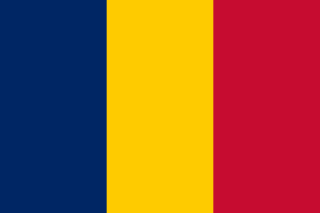
The goat appears prominently in Chadian rural and pastoral life, though the country's flag itself, functionally near-identical to Romania's, remains its most internationally discussed symbol, an entirely unrelated coincidence between the two.
Chad's Sahelian craft traditions include leatherwork and woven mat-making, and camel-hair carpets and jackets, sold in N'Djamena's traditional markets, reflect the country's historic desert trade routes. Traditional Chadian pottery, produced by women in many rural communities, remains an everyday practical craft rather than purely decorative.
The Ennedi Plateau, with dramatic sandstone formations and ancient rock art dating back thousands of years, is a UNESCO World Heritage Site in Chad's remote northeast, and Zakouma National Park protects one of Central Africa's last significant elephant populations.
Zakouma National Park has become a notable conservation success story, with elephant numbers recovering significantly after intensive anti-poaching efforts following severe population declines in the 2000s.
Chad is roughly split between a Muslim majority and a significant Christian minority, with the divide loosely following a north-south geographic line, and the country is home to over 200 distinct ethnic and linguistic groups. Lake Chad, once one of the largest lakes in Africa, has shrunk dramatically in recent decades, significantly affecting the livelihoods of fishing and farming communities who depend on it.
Chad is a significant exporter of crude oil, which forms the overwhelming majority of the country's export revenue, alongside cotton and livestock.
Independence Day on August 11th marks 1960, when Chad gained sovereignty from French colonial rule. Africa Freedom Day on May 25th, shared with several other African nations, commemorates the founding of the Organisation of African Unity, and Chad's national holidays reflect the country's significant religious diversity, with both major Christian and Islamic observances recognised given the roughly even split between the two faiths.
Football holds the largest domestic following in Chad, even without major recent international success to match, and traditional wrestling remains practised across various ethnic communities, tied to specific regional customs and seasonal celebrations, particularly in the country's south. Chadian athletics has grown through participation in regional West and Central African competitions.
Chad is a presidential republic, with a President serving as both head of state and government. The country has experienced significant political instability across its post-independence history, including numerous coups and periods of civil conflict, and Chad's government has more recently faced significant security challenges from instability in neighbouring countries. Chad's government has faced significant recent security pressure from instability in neighbouring Sudan and the wider Sahel region. Chad's oil discoveries in the early 2000s significantly reshaped the country's economy, though instability has limited broader development.
Emi Koussi, a volcanic peak in the Tibesti Mountains, is Chad's highest point at 3,445 metres, rising dramatically from otherwise flat Saharan terrain in the country's remote north. The lowest point is the Bodélé Depression, sitting around 155 metres above sea level, Chad's lowest point despite being well above true sea level, since the country is entirely landlocked.
Romania's flag is functionally identical to Chad's, both use the same blue-yellow-red vertical tricolour, differing only in a very slightly different shade of blue, an entirely coincidental resemblance unrelated to any historical connection between the two countries and one of the most commonly cited examples of accidental national flag confusion anywhere in the world.
Adopted in 1959, functionally identical to Romania's flag apart from a slightly different shade of blue, an entirely unrelated coincidence.
Home to Lake Chad, once one of Africa's largest lakes, now dramatically shrunk over the past 60 years.
Play today's Flagpie →© Flagpie 2026