
Asia
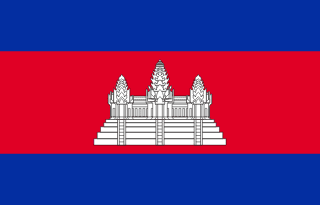
Cambodia sits in Southeast Asia, bordered by Thailand to the north and west, Laos to the northeast, and Vietnam to the east, with a coastline on the Gulf of Thailand.
Cambodia's name comes from Kambuja, an ancient Sanskrit name for the Khmer kingdom, tied to a legendary founding sage in Hindu-influenced Khmer mythology.
Landscape: Dominated by the Tonlé Sap lake and the Mekong River floodplain, with mountains along the Thai and Vietnamese borders.
Climate: Tropical monsoon, hot with a pronounced wet season.
Food: Amok, a coconut-based curry usually made with fish, is widely considered the national dish.
Phnom Penh became Cambodia's capital in 1866 under French colonial influence, though the city's founding legend dates back to the 15th century, when a wealthy widow named Penh is said to have found Buddha statues washed up on the riverbank and built a temple on a nearby hill, giving the city its name. With a population of around 2.3 million, it remains Cambodia's dominant political and economic centre.
The kouprey, a wild forest ox believed possibly extinct, is Cambodia's national animal, and the rumdul, a fragrant white flower, is the national flower.
Khmer silk weaving has roots going back to the Angkor period, and traditional Cambodian silversmithing and stone carving, drawing on techniques used to build Angkor Wat itself, remain practised crafts today. Cambodian classical dance, particularly the Apsara dance depicting celestial nymphs from Hindu-Buddhist mythology, is recognised by UNESCO and remains taught and performed as a significant national art form.
Angkor Wat, the largest religious monument in the world, built in the 12th century, remains Cambodia's most significant landmark by a wide margin, alongside the wider Angkor archaeological complex containing hundreds of other temples.
Cambodia's Cardamom Mountains provide habitat for Asian elephants and, increasingly rarely, tigers, and the Tonlé Sap lake supports one of the most productive freshwater fisheries in the world.
Cambodia is overwhelmingly Theravada Buddhist, deeply woven into daily life, and the country's more recent history includes the Khmer Rouge genocide of the late 1970s, a period that remains a significant part of national memory and cultural reckoning today.
Cambodia is a significant exporter of garments and footwear, alongside rice, with the textile sector forming an especially large share of the country's economy and workforce.
Independence Day on November 9th marks 1953, when Cambodia gained sovereignty from French colonial rule. Khmer New Year in mid-April is the country's most significant traditional celebration, involving temple visits and water-based rituals, and Pchum Ben, a fifteen-day period honouring deceased ancestors, remains a deeply significant Buddhist observance central to Cambodian family and religious life. Cambodia's Royal Ploughing Ceremony in May marks the traditional start of the rice-growing season with royal participation.
Football holds the largest domestic following in Cambodia, and traditional Khmer boxing, pradal serey, shares deep historical roots with Muay Thai and lethwei found in neighbouring countries, remaining a genuinely significant part of Cambodian sporting and cultural life. Volleyball has also grown considerably in popularity in recent decades. Cambodian athletics has grown through increased regional competition participation in recent years.
Cambodia is a parliamentary constitutional monarchy, with the King serving a largely ceremonial role and a Prime Minister holding real executive power, accountable to a bicameral parliament. The country's modern political history has been profoundly shaped by the Khmer Rouge genocide of the late 1970s, a period whose legacy continues to influence Cambodian society and politics today. Cambodia's monarchy, though largely ceremonial today, remains a genuinely unifying national institution. Cambodia's tourism industry, centred significantly on Angkor Wat, forms an increasingly important part of the national economy. Cambodia's garment manufacturing sector has grown into a significant part of the national economy in recent decades.
Phnom Aural is Cambodia's highest point at 1,810 metres. The lowest point sits at sea level along Cambodia's coastline on the Gulf of Thailand.
There's no especially close match for Cambodia's flag, the blue-red-blue horizontal bands with a detailed white silhouette of Angkor Wat at the centre make it one of the only national flags in the world to depict an actual building rather than a symbolic or heraldic emblem, a genuinely distinctive choice.
One of the only national flags in the world to feature a building, adopted in its current form in 1993, though the Angkor Wat image has appeared on various versions of the flag since the 1850s.
Home to Angkor Wat, the largest religious monument in the world.
Play today's Flagpie →© Flagpie 2026