
Africa
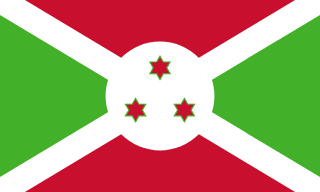
Burundi is a small, landlocked country in East Africa, bordered by Rwanda to the north, Tanzania to the east and south, and the Democratic Republic of the Congo to the west, along the shore of Lake Tanganyika.
Burundi's name comes from the Kirundi language, referring to the land of the Rundi people, whose kingdom existed in the region for centuries before German and later Belgian colonial rule.
Landscape: A small, mountainous, landlocked country on the northeastern edge of Lake Tanganyika.
Climate: Tropical highland, moderated by elevation, with a wet and dry season.
Food: Beans and plantain form the basis of most everyday meals, often served with cassava or maize.
Gitega became Burundi's official political capital in 2019, replacing Bujumbura, which remains the country's largest city and economic centre. Gitega was chosen partly for historical significance, having been the seat of the country's royal court before colonisation, and partly for its more central location.
The drum, specifically the royal karyenda drum, holds deep symbolic and historical significance in Burundian culture, tied to the country's traditional monarchy, and Burundian drumming performances remain recognised by UNESCO as significant intangible cultural heritage.
Burundian drum-making and performance, involving large hollowed tree-trunk drums played in coordinated ensemble routines, is one of the country's most internationally recognised cultural traditions. Traditional Burundian pottery and basketry remain practised in rural communities, often using locally sourced clay and plant fibres.
Lake Tanganyika, one of the deepest and oldest lakes in the world, borders Burundi and is a significant natural landmark, and the source of the Nile, contested with several other East African locations, is claimed by some to lie within Burundi's borders. Rusizi National Park, at the point where the Rusizi River meets Lake Tanganyika, protects significant wetland habitat close to the capital.
Lake Tanganyika supports an extraordinary number of endemic fish species, particularly cichlids, found nowhere else in the world, reflecting the lake's ancient age and long isolation.
Burundi is majority Christian, predominantly Catholic, and the country's Hutu and Tutsi ethnic groups, alongside a smaller Twa population, share a complex and at times deeply painful shared history, including periods of severe ethnic conflict in the late 20th century.
Burundi is a significant exporter of coffee and tea, with agriculture forming the overwhelming majority of the country's economy and export revenue.
Independence Day on July 1st marks 1962, when Burundi gained sovereignty from Belgian administration. Unity Day on February 5th commemorates a 1991 charter aimed at promoting reconciliation between the country's Hutu and Tutsi communities, a date of significant weight given Burundi's history of severe ethnic conflict. Burundi's Ntaryamira Day in April commemorates a former president killed alongside Rwanda's leader in 1994.
Football holds the largest domestic following in Burundi, and the country's drumming tradition, recognised by UNESCO, while not a sport in the conventional sense, is performed with an athleticism and choreographed intensity that carries genuine cultural weight comparable to competitive sport in national life. Burundian athletics has produced notable long-distance runners in international competitions.
Burundi is a presidential republic, with a President serving as both head of state and government. The country experienced a devastating civil war largely along ethnic Hutu-Tutsi lines from 1993 to 2005, and its political system since has included constitutional power-sharing measures specifically designed to prevent a recurrence of that conflict. Burundi remains one of the poorest countries in the world by GDP per capita, a significant ongoing development challenge.
Mount Heha is Burundi's highest point at 2,684 metres. Lake Tanganyika holds the lowest point at around 772 metres above sea level, Burundi's lowest point despite being well above true sea level, since the country is entirely landlocked. Burundi's hilly terrain, earning it the nickname 'land of a thousand hills,' shapes much of its agricultural land use.
There's no especially close match for Burundi's flag, the diagonal white cross dividing red and green sections with three red stars in a central white circle is a distinctive combination, that specific diagonal cross pattern not closely replicated by any other national flag currently in use. Burundi's white diagonal cross is a genuinely uncommon structural choice among African national flags generally.
Adopted in 1967 after the monarchy was abolished, keeping the same diagonal white cross layout from the earlier royal-era flag but replacing the drum and sorghum emblem with three stars.
One of the most densely populated countries in Africa, and one of the poorest by GDP per capita.
Play today's Flagpie →© Flagpie 2026