
Africa
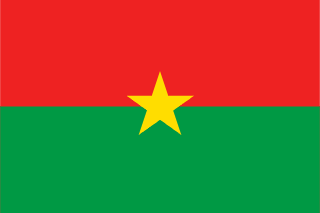
Burkina Faso is a landlocked country in West Africa, bordered by Mali to the north, Niger to the east, Benin and Togo to the southeast, and Ghana, Ivory Coast, and Guinea to the south and west.
Burkina Faso's name combines Mossi and Dyula words meaning roughly 'land of honest/upright people,' adopted in 1984 when revolutionary leader Thomas Sankara renamed the country from Upper Volta.
Landscape: A landlocked plateau, mostly savanna, with the Sahel region in the north bordering the Sahara.
Climate: Hot and dry for most of the year, with a short rainy season.
Food: Riz gras, rice cooked in a rich tomato and meat sauce, is a widely eaten staple dish.
Ouagadougou has served as a significant regional centre since at least the 15th century, historically the capital of the Mossi Empire before French colonisation. With a population of around 2.7 million, it remains Burkina Faso's political and cultural centre, home to one of West Africa's most significant film festivals, FESPACO, held every two years.
The white stallion appears on Burkina Faso's coat of arms, tied to Mossi royal and equestrian tradition, and the country's name itself, meaning 'land of upright people,' functions as a kind of national motto in its own right.
Burkinabé bronze casting and leatherwork reflect deep regional craft traditions, and the country's Bobo and Mossi mask-making traditions, tied to specific ceremonial and spiritual practices, remain actively produced today. Traditional Burkinabé cotton weaving (faso dan fani) became a symbol of national self-reliance during Thomas Sankara's revolutionary government, actively promoted as an alternative to imported textiles.
The ruins of Loropéni, an ancient fortified settlement linked to the historic gold trade, is Burkina Faso's only UNESCO World Heritage Site, and the Sindou Peaks, dramatic rock formations shaped by erosion, are among the country's most striking natural landscapes.
Burkina Faso's Arly National Park, part of a larger cross-border protected area shared with Benin and Niger, supports elephants, lions, and significant savanna wildlife despite ongoing regional security challenges affecting conservation efforts.
Burkina Faso is religiously mixed, with a Muslim majority and significant Christian and traditional African religious minorities, and the country has historically been noted for relatively strong interfaith coexistence.
Burkina Faso is a significant exporter of gold and cotton, with gold mining in particular having grown substantially as a share of the national economy in recent years.
Independence Day on August 5th marks 1960, when Burkina Faso (then Upper Volta) gained sovereignty from French colonial rule. Revolution Day on August 4th, marking Thomas Sankara's 1983 revolutionary takeover, remains significant given Sankara's continued status as an influential and still widely admired figure across much of West Africa despite his assassination in 1987. FESPACO Day, tied to the biennial film festival, draws significant cultural attention when the festival is held.
Football holds the largest domestic following in Burkina Faso, and FESPACO, the Pan-African Film and Television Festival held every two years in Ouagadougou, though not a sport, draws a level of national and continental attention that rivals major sporting events across West Africa. Burkinabé athletics has produced regional competitors despite limited domestic sporting infrastructure.
Burkina Faso's political situation has been in significant flux in recent years, having experienced multiple military coups since 2022 amid ongoing security challenges from extremist violence in the wider Sahel region, with the country currently governed by a military transitional authority rather than an elected civilian government. The country's gold mining sector has grown significantly as a share of the national economy in recent years.
Tena Kourou is Burkina Faso's highest point at 749 metres. The lowest point is along the Mouhoun River valley, sitting around 200 metres above sea level, Burkina Faso's lowest point despite being well above true sea level, since the country is entirely landlocked. Burkina Faso's landlocked, generally flat plateau terrain gives it relatively modest elevation extremes compared to some neighbours.
Ghana and Ethiopia both use the same green-yellow-red horizontal colour combination Burkina Faso does, part of the broader Pan-African tradition, and Burkina Faso's own central yellow star is what distinguishes its specific flag from Ethiopia's plain stripes or Ghana's own black star at the centre. Ethiopia's flag uses the same three colours in a different arrangement, part of the same wider Pan-African tradition.
Adopted in 1984 after a revolution renamed the country from Upper Volta to Burkina Faso, replacing an earlier black-white-red flag.
Landlocked and largely covered by savanna, with over 60 different ethnic groups.
Play today's Flagpie →© Flagpie 2026