
Asia
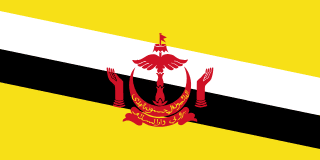
Brunei is a small country on the island of Borneo in Southeast Asia, almost entirely surrounded by Malaysia's Sarawak state, with a coastline on the South China Sea.
This flag has the highest proportion of yellow of any flag in Flagpie, at 55%.
Brunei's name origin is debated, one popular legend traces it to an exclamation meaning 'that's it!' supposedly made by a prince upon finding a suitable place to settle, though this is more folklore than confirmed history.
Landscape: Small, mostly covered by dense rainforest, with a short South China Sea coastline split into two separate parts by Malaysian territory.
Climate: Tropical, hot and humid year-round with heavy rainfall.
Food: Ambuyat, a starchy dish made from the sago palm, is considered the national dish, eaten with a variety of dipping sauces.
Bandar Seri Begawan has served as Brunei's capital for centuries, its name meaning 'city of the illustrious ruler,' referencing the country's long-reigning sultan. With a population of around 100,000, it includes Kampong Ayer, a large historic settlement built entirely on stilts over the Brunei River, sometimes called the 'Venice of the East.'
The Brunei parrotfinch, a small colourful bird, and the simpor flower are both closely associated with the country, alongside the traditional royal umbrella and other regalia significant to the sultanate.
Brunei's silverwork and brasswork traditions date back centuries, tied historically to royal patronage, and traditional Brunei Malay weaving, particularly jong sarat cloth using gold thread, remains produced for formal and royal occasions. Traditional Brunei Malay boat-making, used for the country's iconic water village, reflects centuries of adaptation to life built directly over the river.
The Sultan Omar Ali Saifuddin Mosque, completed in 1958, and the Istana Nurul Iman, the world's largest residential palace and home to Brunei's sultan, are both significant landmarks reflecting the country's continued monarchy.
Brunei's rainforests, largely undeveloped compared to much of the rest of Borneo due to the country's oil wealth reducing pressure for logging, support orangutans, proboscis monkeys, and significant biodiversity.
Brunei is majority Muslim, and Islam plays a central role in the country's governance under its absolute monarchy, with the sultan holding both political and religious authority. Brunei's national philosophy, Malay Islamic Monarchy, formally combines Malay culture, Islamic values, and monarchy into the guiding framework for the country's governance and national identity.
Brunei's economy is dominated by oil and natural gas exports, which fund one of the highest per-capita incomes in Southeast Asia despite the country's small population.
National Day on February 23rd marks 1984, when Brunei gained full sovereignty from British protection, celebrated with elaborate ceremonies given the continued centrality of the Sultanate to national life. The Sultan's birthday in July is similarly treated as a major public holiday, reflecting the monarchy's significant role in Brunei's political and cultural identity. Brunei's Anniversary of Revelation of the Quran in Ramadan remains a significant religious observance nationwide.
Football holds the largest domestic following in Brunei, and traditional pursuits including silat, a Southeast Asian martial art, and various water sports carry genuine cultural significance given the country's coastal geography and its historic water village settlements. Bruneian football has grown steadily through regional Southeast Asian competition participation. Bruneian traditional boat racing remains a popular community event along the country's rivers.
Brunei is an absolute monarchy, with the Sultan holding supreme executive, legislative, and religious authority, a role currently held by one of the longest-reigning monarchs in the world. The country has no elected national legislature with meaningful independent power, governing instead through royal decree alongside an appointed advisory council. Brunei's legal system incorporates Sharia law alongside its common law traditions inherited from British administration. Brunei's substantial oil and gas wealth funds an extensive social welfare system for citizens. Brunei's sovereign wealth fund manages substantial reserves accumulated from decades of oil and gas revenue. Bruneians pay no personal income tax, one of relatively few countries worldwide to offer this.
Bukit Pagon is Brunei's highest point at 1,850 metres. The lowest point sits at sea level along Brunei's short coastline on the South China Sea.
There's no especially close match for Brunei's flag, the diagonal black and white stripes overlaid with the country's detailed national crest, combining a royal umbrella, wings, a crescent, and hands, make it one of the more visually intricate national flags in the world and genuinely distinctive from any other country's design.
The white and black diagonal stripes date to 1906, with the national crest added in 1959 when Brunei gained self-governance from Britain.
One of the wealthiest countries in Southeast Asia due to its oil and gas reserves, ruled by the same royal family for over 600 years.
Play today's Flagpie →© Flagpie 2026