
South America
Brazil is the largest country in South America, taking up nearly half the continent, bordered by almost every other South American country except Chile and Ecuador, with a long Atlantic coastline to the east. Its name comes from brazilwood, a tree once heavily exported for the red dye extracted from it.
Brazil is named after brazilwood, a tree once heavily harvested along its coast for the deep red dye that could be extracted from it, which became one of the colony's earliest valuable exports to Portugal.
Landscape: Dominated by the Amazon rainforest in the north, with savanna, wetlands, and a long Atlantic coastline further south.
Climate: Mostly tropical, with a more temperate climate in the southern states.
Food: Feijoada, a black bean and pork stew, is considered the national dish, alongside barbecue-style churrasco and pão de queijo cheese bread.
Brasília is a purpose-built capital, constructed in the late 1950s specifically to move the seat of government away from the coast and encourage development of the country's interior, replacing Rio de Janeiro. Its layout, designed by urban planner Lúcio Costa with buildings by architect Oscar Niemeyer, is famous enough in its own right to be a UNESCO World Heritage Site, unusual for a city built almost entirely within a single decade.
The golden lion tamarin, a small, strikingly coloured monkey found only in Brazil's Atlantic Forest, is a widely recognised symbol of the country's conservation efforts. The ipê-amarelo, a tree that blooms with vivid yellow flowers, is Brazil's national tree.
Brazilian craft traditions vary hugely by region, shaped by Indigenous, Portuguese, and African influences, from Amazonian basket weaving to the elaborate costumes associated with Carnival, which itself represents a major ongoing craft and design industry each year.
Christ the Redeemer, overlooking Rio de Janeiro from Corcovado mountain, is Brazil's most recognisable landmark, alongside Iguaçu Falls on the Argentine border, one of the largest waterfall systems in the world.
The Amazon rainforest, most of which lies within Brazil, is home to an extraordinary share of the world's biodiversity, including the jaguar, the largest cat in the Americas, and thousands of species found nowhere else on Earth.
Brazil has the largest Catholic population of any country in the world, though Protestant and Evangelical Christianity has grown significantly in recent decades. Brazilian culture also carries strong Afro-Brazilian religious traditions, including Candomblé and Umbanda, brought and adapted by enslaved Africans and their descendants.
Brazil is one of the world's largest exporters of soybeans, coffee, and beef, alongside iron ore and other minerals, with agriculture forming a particularly large share of its export economy.
Carnival, held in the lead-up to Lent each February or March, is Brazil's most internationally famous celebration, with Rio de Janeiro's parade in particular drawing visitors from around the world for its elaborate samba school performances. Independence Day on September 7th marks the 1822 declaration of independence from Portugal, and Festa Junina in June, tied to Catholic saints' days, is celebrated nationwide with bonfires and traditional country-style dress. New Year's Eve on Copacabana Beach draws millions to watch fireworks and, for many, to make offerings to Iemanjá, a goddess of the sea in Afro-Brazilian religious tradition.
Football is treated as something close to a national religion in Brazil, the country having won the World Cup a record five times and produced some of the most celebrated players in the sport's history. Volleyball and mixed martial arts, particularly Brazilian jiu-jitsu, which originated there, both carry significant national pride too. Brazil's beach volleyball and capoeira, a martial art disguised as dance developed by enslaved Africans, both carry genuine cultural weight beyond their competitive standing.
Brazil is a federal presidential republic, with a President serving as both head of state and head of government, elected directly by the population for a four-year term. The country's 1988 constitution, adopted after decades of military rule that ended in 1985, established the current democratic framework, and Brazil operates a notably large multi-party political system.
Pico da Neblina, in the country's far north near the Venezuelan border, is Brazil's highest point at 2,995 metres, sitting deep within the Amazon rainforest and genuinely difficult to access. The lowest point sits at sea level along Brazil's extensive Atlantic coastline.
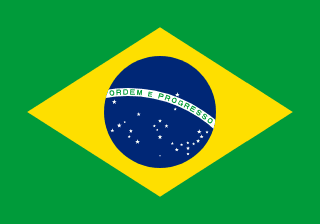
There isn't a close match anywhere in the world for Brazil's flag, the green field with a yellow diamond and blue celestial globe is distinctive enough that no other country comes close to replicating it. The closest anyone gets is other South American countries using yellow and green together, like Jamaica, though the overall design there is different enough that confusion is genuinely unlikely.
The current design dates to 1889, replacing the flag of the Brazilian Empire when the country became a republic, with the star pattern updated several times since to reflect new states.
The most biodiverse country on Earth, home to roughly one-tenth of all known species.
Play today's Flagpie →© Flagpie 2026