
Africa
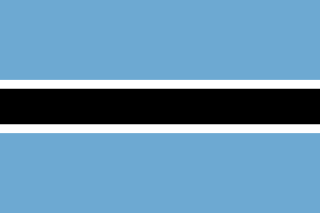
Botswana is a landlocked country in southern Africa, bordered by Namibia to the west and north, Zambia and Zimbabwe to the northeast, and South Africa to the south.
Botswana's name means 'land of the Tswana,' referring to the country's dominant ethnic group, adopted upon independence from Britain in 1966, replacing the colonial name Bechuanaland.
Landscape: Mostly flat, dominated by the Kalahari Desert, with the Okavango Delta, a major wetland, in the north.
Climate: Semi-arid, hot summers and mild, dry winters.
Food: Seswaa, slow-cooked shredded beef, is widely considered the national dish, traditionally served at celebrations.
Gaborone became Botswana's capital upon independence in 1966, a newly planned city built specifically for the role, since the previous colonial administrative centre had actually been located outside the country's own borders, in South Africa. With a population of around 270,000, it remains one of the fastest-growing cities in southern Africa.
The zebra is Botswana's national animal, and its black and white colours are echoed in the country's flag, and the water lily is the national flower, referencing the significance of water in this largely arid country.
Basket weaving, particularly from the Okavango Delta region, is one of Botswana's most internationally recognised crafts, with specific patterns and techniques passed down through generations of Bayei and Hambukushu weavers. San (Bushmen) rock art and storytelling traditions, among the oldest continuous cultural practices in the world, remain preserved in parts of the Kalahari Desert region.
The Okavango Delta, an inland river delta rather than one draining into the sea, is Botswana's most significant natural landmark and a UNESCO World Heritage Site, and the Tsodilo Hills contain one of the highest concentrations of ancient rock art in the world.
Botswana holds one of the largest elephant populations in Africa, concentrated significantly around the Okavango Delta and Chobe National Park, alongside healthy populations of lions, leopards, and African wild dogs.
Botswana is majority Christian, and the country is often cited as one of Africa's most stable democracies since independence, with the Tswana concept of 'kgotla,' a traditional community meeting and decision-making forum, still genuinely influential in local governance.
Botswana is one of the world's largest diamond producers and exporters, with diamond mining forming the overwhelming majority of the country's export revenue and having funded significant infrastructure development since independence.
Independence Day on September 30th marks 1966, when Botswana gained sovereignty from British colonial rule, celebrated nationwide with cultural performances and public festivities. Botswana Day, observed alongside Independence Day, and the surrounding public holiday period reflect the country's particular pride in its post-independence political stability and economic development.
Football holds the largest domestic following in Botswana, and the country has also produced notable success in athletics, particularly in sprinting, at the international level in recent years. Traditional stick fighting and other customary sports remain practised in some rural communities as part of broader cultural heritage. Botswana's basketball and volleyball programmes have grown steadily through recent domestic investment.
Botswana is a presidential republic, with a President serving as both head of state and government. The country is widely regarded as one of Africa's most stable and least corrupt democracies since independence, having maintained continuous multi-party elections and avoided the coups and civil conflicts that affected many of its regional neighbours in the post-independence era. Botswana's diamond wealth has been managed through notably transparent public revenue policy since independence. Botswana's diamond industry, managed through a partnership model, has funded significant public infrastructure since independence.
Tsodilo Hill is Botswana's highest point at 1,489 metres, and the surrounding site holds one of the highest concentrations of ancient rock art in the world. The lowest point is along the Limpopo river valley, sitting around 513 metres above sea level, Botswana's lowest point despite being well above true sea level, since the country is entirely landlocked.
There's no especially close match for Botswana's flag, the light blue field with a black-and-white striped band through the centre is a genuinely distinctive combination, deliberately avoiding the red and green colours common to many other African independence-era flags in favour of blue, representing water and rain, and black-and-white, representing racial harmony.
Adopted in 1966 upon independence, deliberately avoiding red or green to distance itself from other African independence-era flags of the time.
Home to the Okavango Delta, one of the few major river deltas in the world that never reaches the sea.
Play today's Flagpie →© Flagpie 2026