
Europe
Bosnia and Herzegovina sits on the Balkan Peninsula, bordered by Croatia wrapping around most of its north, west, and south, and Serbia to the east, with a tiny strip of coastline on the Adriatic Sea.
Bosnia's name likely comes from the Bosna River, itself possibly derived from an ancient Illyrian word related to water. Herzegovina's name comes from 'herceg,' a Slavic title meaning duke, referring to a 15th-century regional ruler.
Landscape: Mostly mountainous, part of the Dinaric Alps, with a very short Adriatic coastline and river valleys running through the interior.
Climate: Continental inland, Mediterranean along the small coastal strip.
Food: Ćevapi, small grilled sausages served in flatbread, is widely considered the national dish, shared with several neighbouring countries.
Sarajevo has been a significant city since Ottoman times, and became internationally notable as the site of Archduke Franz Ferdinand's assassination in 1914, an event that triggered the First World War. With a population of around 275,000, it also hosted the 1984 Winter Olympics before enduring one of the longest sieges of any capital city in modern history during the 1990s Bosnian War.
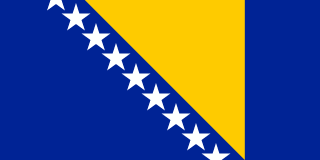
The golden lily, historically tied to medieval Bosnian royalty, remains a significant cultural symbol, and Bosnia's flag, featuring blue, yellow, and white stars, was specifically designed after the war to be ethnically neutral among the country's Bosniak, Serb, and Croat communities.
Bosnian copperwork, particularly in Sarajevo's old Ottoman-era bazaar district, Baščaršija, remains an actively practised craft, and traditional Bosnian carpet weaving reflects centuries of Ottoman cultural influence. Traditional Bosnian sevdalinka music, a melancholic folk style with Ottoman-influenced instrumentation, remains widely performed and considered a significant part of national cultural identity.
The Stari Most (Old Bridge) in Mostar, originally built in the 16th century, destroyed during the 1990s war, and carefully rebuilt afterward, is a UNESCO World Heritage Site and a powerful symbol of the country's post-war reconciliation efforts.
Bosnia's mountainous Sutjeska National Park protects one of the last primeval forests remaining in Europe, home to brown bears and wolves.
Bosnia and Herzegovina is religiously and ethnically diverse, with Bosniak Muslims, Orthodox Christian Serbs, and Catholic Croats forming the country's three main constituent peoples, a diversity central to both the country's culture and its complex post-war political structure.
Bosnia and Herzegovina is a significant exporter of metals, machinery, and furniture, with a manufacturing base still recovering and developing in the decades following the 1990s war.
Independence Day on March 1st marks 1992, when Bosnia and Herzegovina declared sovereignty following a referendum, a date whose observance itself reflects the country's ongoing ethnic divisions, since it isn't marked equally across all communities. Statehood Day on November 25th commemorates a 1943 wartime anti-fascist council meeting considered foundational to the modern Bosnian state. Independence-related commemorations remain observed differently across the country's Bosniak, Serb, and Croat communities.
Football holds the largest domestic following in Bosnia and Herzegovina, the national team's qualification for the 2014 World Cup, its first major tournament appearance as an independent nation, treated as a significant unifying moment for a country whose politics otherwise remain shaped by ethnic division. Basketball and volleyball also both draw significant domestic followings. Bosnian athletes have also competed successfully in judo and wrestling at continental competitions.
Bosnia and Herzegovina has an unusually complex political structure, with a three-member rotating Presidency, one member each representing the Bosniak, Serb, and Croat communities, reflecting the power-sharing arrangement established by the 1995 Dayton Agreement that ended the Bosnian War. The country is further divided into two largely self-governing entities alongside a small separately administered district. The country's post-war reconstruction has been significantly supported by international peacekeeping and development assistance. Sarajevo hosted the 1984 Winter Olympics, a rare distinction for a city later devastated by war just a decade afterward.
Maglić, on the border with Montenegro, is Bosnia and Herzegovina's highest point at 2,386 metres. The lowest point sits at sea level along the country's very short Adriatic coastline, just a few kilometres wide, one of the shortest of any coastal nation.
The European Union's own flag is Bosnia and Herzegovina's closest visual relative, both use blue and gold stars, a deliberate design choice reflecting the country's aspirations toward EU membership, though Bosnia's flag adds a yellow triangle representing its three constituent peoples that the EU's flag doesn't carry.
Designed by Miroslav Šuvalija.
Adopted in 1998 after the Bosnian War, imposed by the international community's High Representative specifically because local politicians couldn't agree on a design.
Home to Sarajevo, the only European capital to have hosted a Winter Olympics while also enduring one of the longest sieges in modern history.
Play today's Flagpie →© Flagpie 2026