
Africa
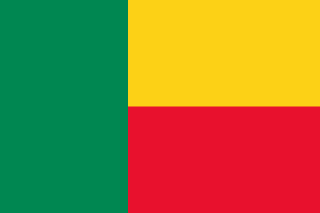
Benin is a narrow country in West Africa, wedged between Togo to the west and Nigeria to the east, with Burkina Faso and Niger to the north and a short coastline on the Gulf of Guinea to the south.
Modern Benin took its current name in 1975, replacing Dahomey, chosen after the historic Bight of Benin, a body of water along the country's coast, itself named after the unrelated Benin Empire located in what is now Nigeria.
Landscape: A narrow country stretching from a short Atlantic coastline north through savanna to the Sahel region.
Climate: Tropical in the south, becoming drier and semi-arid moving north.
Food: Amiwo, a spiced cornmeal dish typically served with a tomato and meat sauce, is a widely eaten staple.
Benin has two capitals in practice, Porto-Novo, the official constitutional capital, and Cotonou, the seat of government and by far the country's largest city. Porto-Novo's name, meaning 'new port' in Portuguese, reflects its origins as a Portuguese trading post, while Cotonou, with a population of around 700,000, functions as the country's actual political and economic centre.
The leopard appears on Benin's coat of arms, tied to the historic Kingdom of Dahomey, whose rulers used the leopard as a royal symbol for centuries.
Beninese bronze and brass casting, historically tied to the Kingdom of Dahomey's royal courts, remains a significant craft tradition, and appliqué textile art, depicting historical and folkloric scenes, is a distinctly Beninese artistic export. Traditional Beninese drumming, closely tied to Vodun ceremonial practice, remains a genuinely significant part of both religious and everyday cultural life.
The Royal Palaces of Abomey, former seat of the Kingdom of Dahomey, are a UNESCO World Heritage Site, and Ganvié, a village built entirely on stilts over Lake Nokoué, is one of Benin's most striking settlements.
Pendjari National Park, in northern Benin, is one of the last strongholds for West African lions and elephants, both increasingly rare across the wider region.
Benin is considered the birthplace of Vodun, or voodoo, which remains an officially recognised religion practised widely alongside Christianity and Islam, a distinctive feature of Beninese religious life compared to many neighbouring countries.
Benin is a significant exporter of cotton, its most important cash crop, alongside cashews and other agricultural products, with the Port of Cotonou also serving as a significant regional trade hub.
Independence Day on August 1st marks 1960, when Benin (then Dahomey) gained sovereignty from French colonial rule. National Vodun Day on January 10th is a genuinely distinctive public holiday, formally recognising and celebrating Benin's status as the birthplace of Vodun religious tradition, drawing practitioners and cultural tourists from across the wider African diaspora.
Football holds the largest domestic following in Benin by a wide margin, even without major international competitive success to match the country's enthusiasm for the sport. Traditional wrestling remains practised in various regional forms, tied to specific ethnic and community customs across the country. Beninese athletics has produced regional competitors despite the country's relatively limited sporting infrastructure. Benin's youth football development programmes have expanded significantly with recent international support.
Benin is a presidential republic, with a President serving as both head of state and government, elected for a five-year term. The country is often cited as one of West Africa's more stable democracies, having pioneered one of the region's earliest peaceful transitions from single-party rule to multi-party democracy in the early 1990s. Benin's 1990 National Conference is widely credited as a pioneering model for peaceful democratic transition across the region. Benin's tourism sector increasingly promotes its status as the birthplace of Vodun to international visitors. Benin has increasingly promoted its Vodun heritage sites as a distinctive cultural tourism draw.
Mont Sokbaro, in the Atakora range, is Benin's highest point at 658 metres. The lowest point sits at sea level along Benin's short Atlantic coastline.
Ghana, Senegal, Guinea, and numerous other West African nations all use variations of Benin's green-yellow-red colour combination, part of the broader Pan-African tradition tracing back to Ethiopia's flag, and Benin's own specific layout, a vertical green band beside horizontal yellow and red stripes, is what most clearly distinguishes it from its regional neighbours' differently arranged versions of the same palette.
First adopted in 1959 before independence, replaced by a Marxist green flag during a communist period from 1975 to 1990, then restored to the original green-yellow-red design.
Widely regarded as the birthplace of Vodun (Voodoo), which remains an officially recognised religion there.
Play today's Flagpie →© Flagpie 2026