
Europe
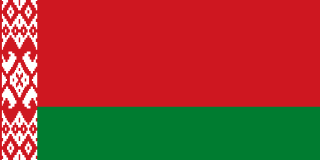
Belarus is a landlocked country in Eastern Europe, bordered by Russia to the east, Ukraine to the south, Poland to the west, and Lithuania and Latvia to the north. Its name roughly translates to 'White Russia.'
Belarus's name means 'White Russia' or 'White Rus',' with the 'white' element's exact historical meaning debated, possibly referring to an unconquered region, a particular clothing style, or a geographic direction in old Slavic colour symbolism.
Landscape: Mostly flat and low-lying, heavily forested, dotted with thousands of lakes and extensive marshland (the Pripet Marshes).
Climate: Temperate continental, cold snowy winters and mild summers.
Food: Draniki, potato pancakes, are a genuine everyday staple, alongside a strong tradition of mushroom foraging and pickling.
Minsk was first documented in 1067 and became capital of modern Belarus following independence from the Soviet Union in 1991. With a population of around 2 million, it was almost entirely rebuilt after extensive destruction during the Second World War, giving it a notably uniform mid-20th-century Soviet architectural character.
The European bison, or wisent, found in Belarus's Białowieża Forest, is the country's national animal, and the cornflower is the national flower, closely tied to traditional Belarusian folk dress and design.
Belarusian straw weaving, using rye straw to create intricate decorative items, is recognised by UNESCO, and traditional Belarusian linen textiles, woven with distinctive geometric patterns, remain a significant national craft. Traditional Belarusian ceramics and woodcarving remain practised in rural workshops, often incorporating pre-Christian Slavic decorative motifs alongside more recent influences.
The Mir Castle Complex and Białowieża Forest, one of the last and largest remaining fragments of the primeval forest that once covered much of Europe, are both UNESCO World Heritage Sites. The Brest Fortress, site of fierce resistance during the German invasion in 1941, remains one of the country's most significant historical memorials.
Białowieża Forest, shared with Poland, holds one of the largest surviving European bison populations, alongside wolves, lynx, and significant old-growth forest habitat rare elsewhere in Europe.
Belarus is majority Orthodox Christian, with a significant Roman Catholic minority, and the country's culture and language remain closely tied to, while also distinct from, both Russian and Polish influence given its position between the two.
Belarus is a significant exporter of potash, machinery, and refined petroleum products, with close economic ties to Russia shaping much of its trade relationships.
Independence Day on July 3rd marks 1944, when Minsk was liberated from Nazi occupation during the Second World War, a notably different basis for a national day compared to most countries, since it doesn't mark sovereignty from a colonial or imperial power in the usual sense. Victory Day on May 9th, shared with Russia, commemorates the defeat of Nazi Germany and remains one of Belarus's most significant patriotic observances. Belarus's Constitution Day in March marks the country's post-Soviet founding legal framework.
Ice hockey and biathlon both hold significant places in Belarusian sporting culture, the country having produced notable Olympic competitors in both disciplines. Gymnastics has also produced multiple Belarusian Olympic champions, and football and tennis both draw significant domestic followings. Belarusian rhythmic gymnastics has produced multiple world and Olympic champions relative to the country's size.
Belarus is a presidential republic, with a President holding substantial executive authority alongside a bicameral National Assembly. The country has been led by the same President since 1994, one of the longest continuous tenures of any current world leader, and Belarus maintains particularly close political and economic ties with neighbouring Russia. Belarus maintains one of the more centralised economic systems in Europe, with significant state ownership. Belarus hosted the 2014 Ice Hockey World Championship, reflecting the sport's significant domestic popularity.
Dzyarzhynskaya Hara is Belarus's highest point at just 345 metres, reflecting the country's generally flat, low-lying terrain. The lowest point is along the Neman River near the Lithuanian border, sitting around 90 metres above sea level, Belarus's lowest point despite being well above true sea level, since the country is entirely landlocked.
There's no especially close match for Belarus's flag, the red-and-green horizontal bands bordered by a traditional red-and-white ornamental pattern along the hoist are a distinctive combination, that decorative pattern in particular, drawn from traditional Belarusian folk textile design, not closely replicated by any other national flag.
The current flag is a modified version of Belarus's Soviet-era flag, readopted in 1995 after a national referendum, replacing a white-red-white flag used briefly after independence.
Home to the Białowieża Forest, one of the last and largest remaining parts of the primeval forest that once covered much of Europe.
Play today's Flagpie →© Flagpie 2026