
Asia
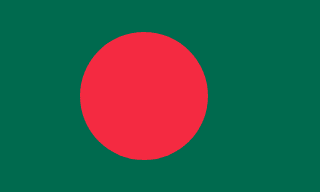
Bangladesh sits in South Asia, almost entirely surrounded by India except for a short border with Myanmar to the southeast, with a coastline on the Bay of Bengal to the south.
Bangladesh's name means 'country of Bengal,' combining 'Bangla,' the local name for the Bengal region and language, with 'desh,' meaning country, adopted upon independence from Pakistan in 1971.
Landscape: Mostly flat, low-lying delta formed by the Ganges and Brahmaputra rivers, making it highly fertile but also prone to flooding.
Climate: Tropical monsoon, hot and humid with a pronounced rainy season and regular cyclone risk.
Food: Rice and fish form the backbone of most meals, with hilsa fish holding particular cultural significance.
Dhaka has roots going back centuries as a Mughal provincial capital and trading centre, later becoming capital of independent Bangladesh in 1971. With a population of around 10 million in the city itself, and over 22 million across the wider metropolitan area, it's among the most densely populated cities in the world.
The Bengal tiger, shared culturally with neighbouring India, is Bangladesh's national animal, found in the Sundarbans, the largest mangrove forest in the world, which the two countries share. The water lily is the national flower, reflecting Bangladesh's landscape of rivers and wetlands.
Muslin, an extremely fine handwoven cotton fabric once produced in the Dhaka region, was famous across the ancient and medieval world for its quality before the craft largely died out under colonial-era trade restrictions, though revival efforts continue today. Bangladesh also has a strong tradition of jamdani weaving, a hand-loom technique recognised by UNESCO.
The Sundarbans mangrove forest, shared with India, is a UNESCO World Heritage Site and home to the Bengal tiger, and the Somapura Mahavihara, a ruined Buddhist monastery dating back over a thousand years, is another of Bangladesh's significant historic sites.
The Bengal tiger and Ganges river dolphin are both found in Bangladesh's extensive river and wetland systems, though both face significant conservation pressure from habitat loss and human population density.
Bangladesh is overwhelmingly Muslim, predominantly Sunni, with a significant Hindu minority, and Bengali cultural identity, including language, played a central role in the country's independence movement and separation from Pakistan.
Bangladesh has become one of the world's largest exporters of ready-made garments, with the textile and clothing sector forming an especially large share of the national economy and workforce.
Independence Day on March 26th marks 1971, when Bangladesh declared independence from Pakistan following a brutal nine-month war, and Language Movement Day on February 21st, commemorating protesters killed in 1952 defending the right to use Bengali, is honoured globally as International Mother Language Day, a rare instance of a national tragedy shaping a worldwide UN observance. Pohela Boishakh, the Bengali New Year in mid-April, is celebrated with colourful street processions regardless of religion, a genuinely unifying secular cultural holiday.
Cricket holds an enormous following in Bangladesh, treated with something close to the same devotion found across much of South Asia, and the national team's steady rise in the sport has become a significant source of national pride. Kabaddi, a traditional contact sport, holds status as the national sport, though it draws considerably less everyday attention than cricket.
Bangladesh is a parliamentary republic, with a largely ceremonial President as head of state and a Prime Minister holding real executive power, accountable to a single-chamber parliament. The country's politics has historically been dominated by rivalry between two major parties, and Bangladesh has experienced significant recent political upheaval, including a major 2024 protest movement that led to a change in government.
Saka Haphong, in the Chittagong Hill Tracts, is generally recognised as Bangladesh's highest point at 1,052 metres, though the exact tallest peak has historically been disputed given the remote, difficult-to-survey terrain. The lowest point sits at sea level across Bangladesh's low-lying delta, much of which is only slightly above the Bay of Bengal.
Japan's flag uses the same basic idea of a circle set against a plain field, though Bangladesh's is red on green rather than red on white, and positioned slightly off-centre rather than dead centre, similar enough in concept that the two are sometimes mentioned together despite the different colours. Palau's flag, a yellow circle on blue, follows the same simple single-circle design principle too, different enough in colour that confusion between it and Bangladesh specifically is less likely.
Designed by Kamrul Hassan.
Adopted in 1972 after independence from Pakistan, adapted from a version first flown during the 1971 liberation war, which originally included a map of the country inside the red circle, later removed for simplicity.
One of the most densely populated countries in the world, home to over 170 million people in an area smaller than the US state of Iowa.
Play today's Flagpie →© Flagpie 2026