
Africa
Angola sits on the Atlantic coast of southern Africa, bordered by the Democratic Republic of the Congo to the north and east, Zambia to the east, and Namibia to the south.
Angola's name comes from 'ngola,' a royal title used by rulers of the Ndongo Kingdom, which the Portuguese encountered and misapplied as the name for the wider territory they went on to colonise.
Landscape: A narrow coastal plain rising to a large central plateau, with the Namib Desert extending into the south.
Climate: Tropical, though moderated by altitude on the plateau, with a distinct wet and dry season.
Food: Muamba de galinha, a chicken stew made with palm oil, is widely considered the national dish.
Luanda was founded by the Portuguese in 1576, making it one of the oldest European-founded cities in sub-Saharan Africa, and grew into a major Atlantic slave trade port before later becoming Angola's capital upon independence in 1975. With a population of around 9 million across the metropolitan area, it's now one of the most expensive cities in the world to live in, driven by oil wealth.
The red-crested turaco, a strikingly coloured bird, is closely associated with Angola, and the welwitschia, an extraordinary desert plant that can live for well over a thousand years, is found only in the Namib Desert region shared with Namibia.
Angolan wood carving and mask-making, particularly among the Chokwe people, reflect a rich artistic tradition with deep spiritual significance, and traditional Angolan textile patterns vary significantly across the country's many ethnic groups. Traditional Angolan basket weaving and pottery vary distinctly by region, with each of the country's major ethnic groups maintaining its own recognisable style and technique.
Kalandula Falls, one of the largest waterfalls in Africa by volume, and the Tundavala Gap, a dramatic escarpment offering sweeping views, are among Angola's most striking natural landmarks.
The giant sable antelope, found only in Angola and once feared extinct due to decades of civil war, has become a powerful national symbol of conservation recovery.
Angola is majority Christian, split between Catholic and Protestant traditions, a legacy of Portuguese colonisation, and the country is home to numerous ethnic groups including the Ovimbundu, Ambundu, and Bakongo.
Angola is a major oil producer and exporter, one of the largest in sub-Saharan Africa, with crude oil forming the overwhelming majority of the country's export revenue.
Independence Day on November 11th marks 1975, when Angola gained sovereignty from Portugal following a lengthy liberation struggle, though independence was immediately followed by a devastating civil war that lasted until 2002. Peace and National Reconciliation Day on April 4th commemorates the end of that civil war, a date of profound significance given the conflict's toll on the country. Angola's Youth Day in April celebrates the country's young population with cultural and sporting events nationwide.
Basketball holds a genuinely significant place in Angolan sporting culture, unusual for a southern African nation, the national team having qualified for the FIFA World Cup in football too but built its strongest international reputation on the basketball court, dominating African continental competition for decades. Football also draws a large domestic following. Angolan handball has also achieved notable continental success in recent decades.
Angola is a presidential republic, with a President serving as both head of state and government. The country's post-independence history was shaped profoundly by a 27-year civil war between rival liberation movements, fuelled significantly by Cold War-era foreign involvement, and Angola has pursued a period of reconstruction and oil-funded development since the conflict's end in 2002. Angola's post-war reconstruction has relied heavily on oil revenue and foreign investment partnerships. Angola's capital, Luanda, has been ranked among the most expensive cities in the world at various points.
Mount Moco is Angola's highest point at 2,620 metres. The lowest point sits at sea level along Angola's Atlantic coastline.
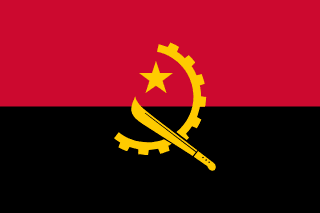
There's no especially close match for Angola's flag, the black-and-red horizontal split with a yellow emblem combining a cogwheel, machete, and star at the centre is distinctive enough in its deliberately socialist-influenced imagery, a design style shared conceptually with a small number of other formerly Marxist-aligned independence movements but not closely replicated by any other current national flag.
Adopted in 1975 at independence from Portugal, its machete-and-gear emblem deliberately styled to evoke the hammer and sickle, reflecting the Marxist government that led the country to independence.
Home to Kalandula Falls, one of the largest waterfalls in Africa by volume.
Play today's Flagpie →© Flagpie 2026