
Africa
Algeria is the largest country in Africa by land area, sitting on the Mediterranean coast of North Africa, bordered by Morocco and Western Sahara to the west, Mauritania, Mali, and Niger to the south, and Libya and Tunisia to the east.
Algeria's name comes from its capital, Algiers, itself derived from the Arabic 'al-jaza'ir,' meaning 'the islands,' referring to small islands that once sat just off the city's coast before land reclamation absorbed them into the mainland.
Landscape: The largest country in Africa by area, over four-fifths of it covered by the Sahara Desert, with the fertile Tell Atlas region along the northern coast.
Climate: Mediterranean along the coast, hot and extremely arid across the Saharan interior.
Food: Couscous is considered the national dish, often served with a spiced stew of meat and vegetables.
Algiers has been a significant Mediterranean port since Phoenician and Roman times, later becoming a major base for Ottoman-era corsairs before French colonisation in 1830. With a population of around 2.9 million, its old quarter, the Casbah, is a UNESCO World Heritage Site reflecting centuries of layered Ottoman and Islamic architecture.
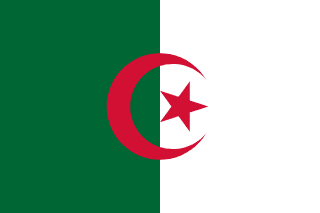
The fennec fox, a small nocturnal desert fox with distinctively oversized ears, is closely associated with Algeria and the wider Sahara region. The star and crescent, appearing on Algeria's flag, are shared symbols across much of the Islamic world.
Algerian craft traditions include intricate silver jewellery, particularly from Kabylie, a mountainous Berber region, and carpet weaving traditions shared across much of North Africa. Algerian rug and carpet weaving, particularly from the Atlas Mountains region, follows patterns and techniques passed down through generations of Berber weavers.
The Casbah of Algiers, a densely packed historic quarter, and the Roman ruins at Timgad, remarkably well preserved despite being built nearly 2,000 years ago, are both UNESCO World Heritage Sites. The M'Zab Valley, a cluster of fortified desert towns built over a thousand years ago by the Ibadi Muslim community, remains inhabited today and reflects a distinctive regional architectural tradition.
Algeria is overwhelmingly Muslim, predominantly Sunni, and the country's Berber, or Amazigh, population represents its Indigenous inhabitants, with Berber language and identity gaining increasing official recognition in recent decades.
Algeria is a significant exporter of crude oil and natural gas, with hydrocarbons forming the overwhelming majority of the country's export revenue.
Independence Day on July 5th marks 1962, following a long and bloody war of independence from France, and Revolution Day on November 1st commemorates the start of that war in 1954, both dates carrying profound national significance given the scale of the conflict. Eid al-Fitr and Eid al-Adha are both major holidays given Algeria's Muslim population. Yennayer, the Amazigh (Berber) New Year in January, became an official public holiday in 2018, reflecting increased recognition of Algeria's Indigenous heritage.
Football holds the largest following in Algeria by a wide margin, the national team having won the Africa Cup of Nations multiple times, and Algeria has also produced world-class middle- and long-distance runners, several of whom have won Olympic medals. Algerian football has grown significantly in regional standing, the national team having won the Africa Cup of Nations in 2019.
Algeria is a presidential republic, with a President serving as both head of state and government, elected for five-year terms. The country's modern political system emerged from a long and difficult war of independence against France, and Algeria later experienced a brutal civil war through the 1990s between the government and Islamist groups, a period that continues to shape its political caution today.
Mount Tahat, in the Ahaggar Mountains deep in the Sahara, is Algeria's highest point at 2,908 metres, an unexpected mountain range rising from otherwise flat desert terrain. The lowest point is Chott Melrhir, a salt lake depression, sitting around 40 metres below sea level.
Pakistan's flag shares the same crescent-and-star symbolism Algeria's does, though on a green-and-white field arranged as a striped design rather than Algeria's vertical split, different enough overall that the two aren't especially likely confused. Tunisia and Turkey both also carry crescent-and-star symbolism on red fields, a different enough base colour from Algeria's green-and-white that they're more readily distinguished.
Adopted in 1962 upon independence from France, based on a design first used by Algerian nationalist movements decades earlier.
The largest country in Africa by land area.
Play today's Flagpie →© Flagpie 2026